Why Your Ancestor’s Name Was Not Changed at Ellis Island — And What Really Happened
Almost every American family with immigrant roots carries some version of this story. An ancestor arrived at Ellis Island. An immigration officer couldn’t pronounce the name, so he wrote down something simpler. The family has used that name ever since. It’s a powerful story. It’s also, in almost every case, not true — and understanding what actually happened instead is the key to finding your ancestor in the records.
The Story Every Family Tells
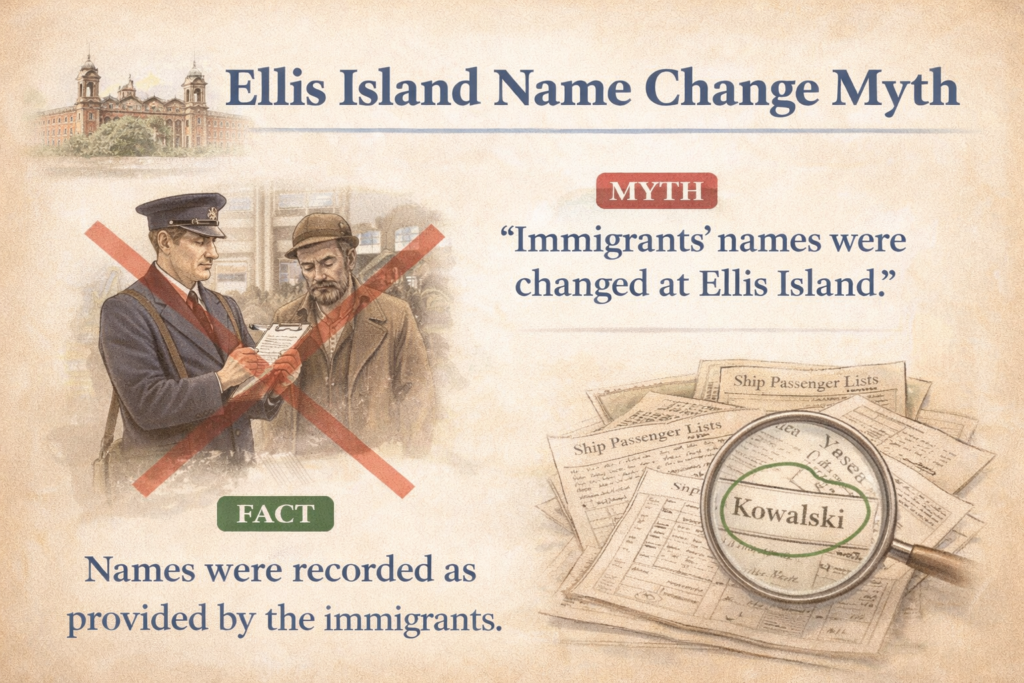
The Ellis Island name change myth is one of the most persistent stories in American family history. It exists in virtually every immigrant community — Irish, Italian, Polish, Jewish, Greek, Hungarian. The details vary but the structure is always the same. An official couldn’t handle the foreign name, simplified it on the spot, and the family had no choice but to accept it.
It is an appealing story because it explains something that genuinely needs explaining — why the name in American records looks so different from the name in the old country. It also carries a quiet tragedy, a sense of identity lost at the border, that resonates across generations. Families hold onto it.
But genealogists and historians who have studied Ellis Island records in detail have found almost no evidence that it happened in any systematic way. The reasons why are worth understanding.
How Ellis Island Actually Worked
When a ship arrived at Ellis Island, inspectors did not ask immigrants their names and write them down from scratch. They worked from a manifest — a passenger list that had been prepared at the port of departure, usually in Europe, before the ship ever left. The name on that manifest was already written down before the immigrant set foot in America.
The inspector’s job was to check the person in front of them against the name already on the manifest, ask a series of standardised questions, and process them through. They were not creating new records — they were checking existing ones. Changing a name on the manifest would have required crossing out an official document, which was not standard procedure.
The Inspectors Were Often Multilingual
Ellis Island at its peak processed immigrants from dozens of countries. The Bureau of Immigration knew this and hired inspectors accordingly. Many inspectors spoke two, three, or four languages. Interpreters were available for languages the inspectors themselves did not speak. The image of a monolingual American clerk baffled by a foreign name and just writing down something simpler does not match the institutional reality of how Ellis Island operated.
This is not to say the process was smooth or dignified — it was often neither. It was exhausting, dehumanising, and frightening for the people going through it. But the specific failure point of a name being changed on the spot by a confused official is not well supported by the evidence.
So Where Did the Name Change Actually Happen?
The name change happened gradually, in the community, over months and years after arrival. And in most cases it was chosen — not imposed.
An immigrant named Wojciech Kowalczyk arrived in New York and found work in a factory. His foreman couldn’t pronounce Wojciech, so he called him Albert. His workmates called him Al. Within a year he was Albert Kowalski on his pay stub because Kowalczyk was also proving difficult. Within five years he was Al Koval because even Kowalski was too much for the neighbourhood. By the time he applied for citizenship he put down Albert Koval because that was who he had become.
This process was driven by the immigrant themselves, by economic necessity, by the desire to fit in, by the practical reality of living in an English-speaking world with a name that English speakers could not handle. It was not done to them at the border. It was done by them, over time, because it made their lives easier.
Why the Myth Matters for Your Research
If you believe the Ellis Island name change story, you will search the wrong records in the wrong way. You will look for your ancestor’s American name in the passenger lists and find nothing, because the passenger list has their original name — the one they arrived with, not the one they ended up with.
The original name is in the passenger list. The changed name appears later — in the census, in naturalisation records, in city directories, in church records from their American parish. There is almost always a period of transition visible in the records if you know where to look, a decade or two where the name shifts gradually from one form to another.
The Port of Departure Is Where the Real Errors Happened
If a name was going to be mangled in the immigration process, the most likely place for it to happen was not Ellis Island — it was the European port of embarkation. Clerks in Hamburg, Bremen, Liverpool, or Genoa were the ones creating the original manifest entry. They were working fast, handling names from countries and languages they may not have known well, and their errors became the official record that followed the immigrant across the Atlantic.
A Polish name recorded badly by a German clerk in Hamburg would arrive at Ellis Island already wrong. The Ellis Island inspector would copy the wrong name from the manifest. The immigrant would carry the wrong name into America. And the family story would eventually attribute the error to Ellis Island, because that is where the immigrant entered the country, even though the mistake happened weeks earlier on the other side of the ocean.
When searching passenger records, search for your ancestor’s original name — the one they used in the old country — not their American name. The manifest was prepared before departure and reflects the European spelling. If you only know the American name, use our Ancestor Name Bridge to work backwards to the likely original form before searching passenger records.
When the Story Is True
It would be wrong to say name changes at the point of immigration never happened. They did, occasionally. A clerk who was rushed, careless, or genuinely baffled might record something quite different from what was said. Immigrants who could not read English had no way of checking what had been written. In some cases the discrepancy between the European record and the American record does appear to have originated at the point of entry.
But these were exceptions, not the rule. And even when they happened, they were far more likely to have occurred at the European port than at Ellis Island itself.
The more useful question for your research is not where the name changed, but what it changed from and what it changed to — and how to find your ancestor on both sides of that change. That is what the records will tell you, if you know how to read them.
Find your ancestor’s original name before they arrived
Our Ancestor Name Bridge works in both directions — enter the American name to find likely original variants for passenger record searches, or enter the ship log name to find the American forms to search in census records.