Why Hungarian Names Are Written Backwards — And What That Means for Your Research
You are searching for your Hungarian great-grandmother. Her name, according to family stories, was Varga Erzsébet. You search every database you can find for Elizabeth Varga and find nothing. You try Erzsebet Varga and find nothing. You try every spelling variation you can think of. Still nothing. The reason you cannot find her may be the simplest one of all — you have her first and last name the wrong way around.
Hungary’s Name Order: Surname First, Given Name Second
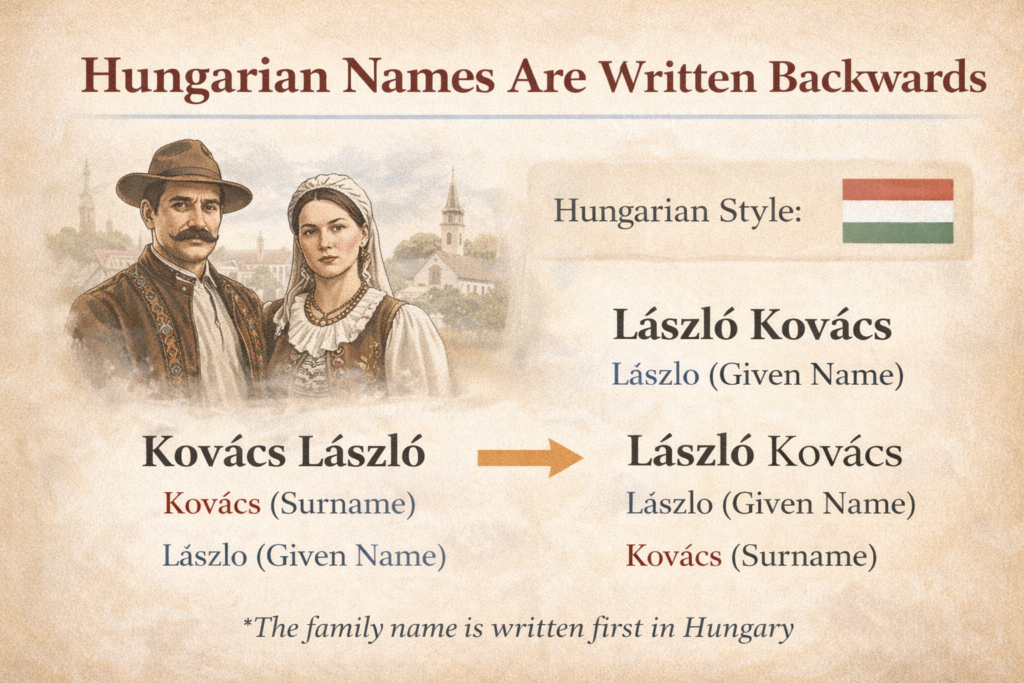
Hungarian is one of a small number of languages in the world that traditionally places the family surname before the given name. In Hungarian, the family you belong to is identified first, and your individual name comes second. Varga Erzsébet means Erzsébet of the Varga family — but in Hungarian, Varga comes first.
This is not a quirk or an informal preference. It is the standard, correct Hungarian name order, used in official documents, in literature, in everyday speech. Every Hungarian knows that Varga Erzsébet’s surname is Varga and her given name is Erzsébet. The problem arises entirely when Hungarian names encounter systems designed around Western European name order — which is to say, when Hungarian immigrants arrived in America.
The same person, two name orders
What Happened at the Border
When a Hungarian immigrant arrived at an American port and presented their name, or when their name was read from a ship manifest by an American clerk, the potential for confusion was immediate. The name Kovács István could be recorded as István Kovács — which would be correct — or it could be recorded as Kovács István, with the clerk assuming that Kovács was the given name and István was the surname. This was not a rare mistake. It happened constantly.
The result in American records is that some Hungarian ancestors appear with their names correctly transposed into English order, while others appear with their Hungarian order preserved — meaning their surname looks like a first name and their first name looks like a surname. And in some cases different records for the same person made different assumptions, so the same individual appears one way in a ship manifest and the other way in a census.
Hungarian Names in American Records
The confusion about name order was compounded by the considerable difficulty American clerks had with Hungarian pronunciation and spelling. Hungarian is not a Slavic language or a Germanic language — it is a Uralic language, entirely unrelated to the languages most American clerks would have encountered. Its sounds, its letter combinations, and its grammar are completely unlike English.
The letter combination “gy” in Hungarian produces a sound roughly like the “dy” in “duty” — something English spelling has no natural equivalent for. Gyorgy (George) was written as Dyordy, Gyorgy, Georgi, or simply George, depending on how the clerk approached it. The “sz” combination produces a simple “s” sound, so Szabo became Sabo or Czabo or Szabo depending on whether the clerk transliterated or approximated. The “cs” combination produces a “ch” sound. The double acute accent on ő and ű produce sounds that do not exist in English.
Austria or Hungary? The Country of Origin Problem
Hungarian immigrants face an additional complication in American records that has nothing to do with their names. From 1867 until 1918, Hungary was part of the Austro-Hungarian Empire, a dual monarchy in which Austria and Hungary were formally equal partners under a shared emperor. At American ports and in American census records, immigrants from this empire were almost universally recorded as Austrian — regardless of whether they came from the Austrian half or the Hungarian half.
This means that searching for Hungary or Hungarian as a birthplace in census records will often find nothing. Your ancestor’s census entry will list Austria, or Austro-Hungary, or sometimes just Austria-Hungary. Only in the 1920 census, after the empire had dissolved following the First World War, do records begin to clearly distinguish Hungarian from Austrian ancestry.
When searching census records for a Hungarian ancestor, use Austria as the birthplace filter rather than Hungary. In the 1900 and 1910 censuses particularly, look for mother tongue listed as Hungarian or Magyar alongside an Austrian birthplace — this combination almost always indicates a Hungarian immigrant rather than an Austrian one.
Hungarian First Names and Their American Equivalents
Hungarian given names have a different set of equivalents from the names you might expect based on other European languages. István became Stephen or Steven, not the Italian Stefano or the German Stefan. Erzsébet became Elizabeth. Mihály became Michael. Gyula — a distinctly Hungarian name with no direct Western equivalent — often became Julius, which shares no obvious connection but was the closest available American option.
Sándor, the Hungarian form of Alexander, frequently became Alexander or Alex in American records — but it also sometimes became Sandy, which preserves the sound of the original more faithfully than Alexander does. If you find a Sandy in an otherwise Hungarian family, that is almost certainly a Sándor.
Putting It Together for Your Search
Searching for a Hungarian ancestor requires holding several things in mind simultaneously. The name order may be reversed in any given record. The given name will have an English equivalent that may not be immediately obvious. The surname will have undergone phonetic approximation by an English clerk. And the country of origin will almost certainly say Austria rather than Hungary.
Work backwards from what you know. Find the family in the earliest American census available and note the birthplace, mother tongue, and immigration year. Use the immigration year to narrow your search in passenger records. Search passenger records with the name in Hungarian order as well as English order, and with every phonetic variant you can construct.
Find the English equivalents of Hungarian names
Our Ancestor Name Bridge covers Hungarian name transformations in both directions — including the reversed name order that catches so many researchers out.