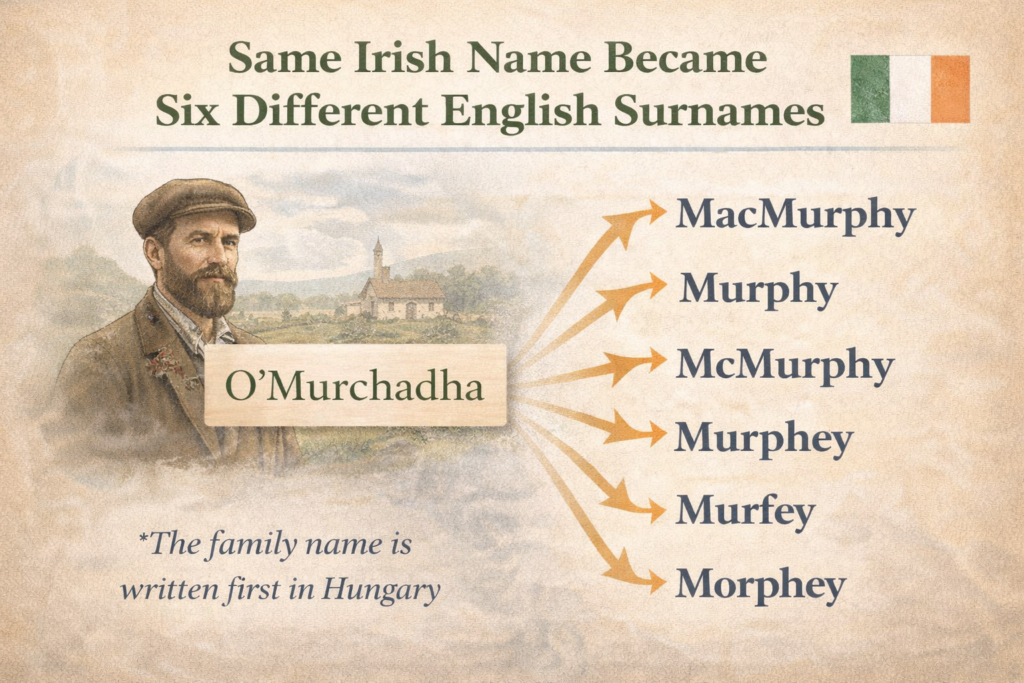
Why the Same Irish Name Became Six Different English Surnames
Three branches of the same family left County Mayo in the 1840s. One settled in Boston and became Sullivan. One went to New York and became O’Sullivan. One ended up in Philadelphia as Sullivane. They all started as Ó Súilleabháin. If you are researching Irish ancestry and wondering why cousins seem to have completely different surnames, this article explains exactly how that happened — and how to find them all.
Irish Names Before the English Got to Them
Irish surnames as they existed in Gaelic Ireland were rich, poetic, and linguistically complex. They followed a consistent structure built around the Gaelic prefixes Ó (meaning grandson or descendant of) and Mac or Mc (meaning son of), followed by the name of a famous ancestor. Ó Súilleabháin meant descendant of Súilleabhán, a name meaning sharp-eyed. Ó Briain meant descendant of Brian. Mac Cárthaigh meant son of Carthach.
These names had been in use for centuries and were deeply meaningful within Irish culture. The problem — for genealogists today — is that they were written in the Irish language, which has a set of phonetic rules entirely unlike English. Silent letters, initial mutations that change the first consonant of a word depending on grammatical context, and vowel sounds that English spelling cannot easily represent all combined to make Irish names look and sound completely alien to English ears.
Seven Centuries of Anglicisation
English colonisation of Ireland began in the twelfth century and had a profound effect on Irish naming over the following centuries. As English administration spread, Irish names were required to appear in English documents — court records, land surveys, tax rolls — and English clerks made their own guesses at how to render Gaelic sounds in English letters.
There was no standard system. Different clerks in different counties in different centuries made different decisions. The same name might be anglicised one way in Munster, another way in Connacht, and a third way in Ulster. The same family’s name might appear differently in records from the same decade, simply because different officials handled different documents.
The O’ That Came and Went
One of the most significant and confusing features of Irish name history is the fate of the Ó prefix. During the seventeenth and eighteenth centuries — a period of severe repression of Irish culture — many Irish families dropped the Ó from their name entirely. O’Brien became Brien or Brian. O’Neill became Neil or Neale. O’Sullivan became Sullivan.
Then, from the late nineteenth century onward, as Irish cultural identity experienced a revival, many families restored the Ó prefix. O’Brien came back. O’Neill returned. But not universally — some branches of the same family had the prefix restored while others did not, and some families in America had already been using the prefix-less version for so long that they kept it.
The result is that the same extended family today may have members named Brien, Brian, Bryan, O’Brien, O’Bryan, and O’Brian — all descended from the same Ó Briain ancestors, the variations determined entirely by which generation made which decision about the prefix.
The Sounds That English Could Not Handle
Irish has sounds that simply do not exist in English, and the attempts to represent them in English spelling produced multiple different solutions for the same sound. The Irish “bh” and “mh” both produce a “v” or “w” sound. The “dh” and “gh” produce sounds that range from a soft “y” to a guttural sound with no English equivalent. The “th” in Irish sounds like “h.”
🇮🇪 One Irish name, many English outcomes
Regional Dialects Made It Worse
Irish was not a single uniform language — it had (and still has) three major dialects: Munster, Connacht, and Ulster Irish. The same word could be pronounced quite differently in Cork than in Galway than in Donegal. When emigrants from different regions arrived at the same American port and their names were recorded by the same clerk, the same underlying Irish name could produce completely different English spellings depending on which dialect the immigrant spoke.
A family named Ó Faoláin from Cork might pronounce it in a way that became Whelan in English. The same family from Galway might pronounce it in a way that became Phelan. Both are correct anglicisations of the same name — just from different dialects.
First Names: The Same Problem
Irish given names were equally unstable in translation. Seán (the Irish form of John) became Sean, Shane, Shawn, Shaun, or John depending on who was recording it. Séamus (James) became James, Hamish, or Shamus. Siobhán — a name pronounced something like “Shih-VAWN” — became Joan, Shevaun, Shevaune, Chevonne, or simply Jane.
The Irish name Tadhg — pronounced something like “Tige” — became Timothy, Thaddeus, Teague, or Tighe in English. None of these look anything like Tadhg and none of them sound exactly like it either. If you are searching for a Tadhg in Irish records and a Timothy in American records, you may be looking for the same person.
When researching Irish ancestors, always search for multiple O’ prefix variants — with the prefix, without it, and with alternative spellings of the prefix such as O (no apostrophe). Also search for phonetically similar surnames that seem unrelated — Whelan and Phelan, Sullivan and Sullivane, Walsh and Welsh are all worth trying for the same family line.
How to Trace the Variants
The most effective strategy for Irish surname research is to identify the Irish original first — even approximately — and then search for every anglicised variant rather than committing to one spelling. Griffith’s Valuation (1847–1864), a comprehensive survey of Irish landholders, gives you the spelling used in Ireland just before and during the Famine emigration. That spelling is your closest link between the old country name and whatever appears in American records a decade later.
Find all the English variants of your Irish ancestor’s name
Our Ancestor Name Bridge covers Irish name transformations in both directions — find likely ship log names from an American surname, or find all the American forms of an Irish original.