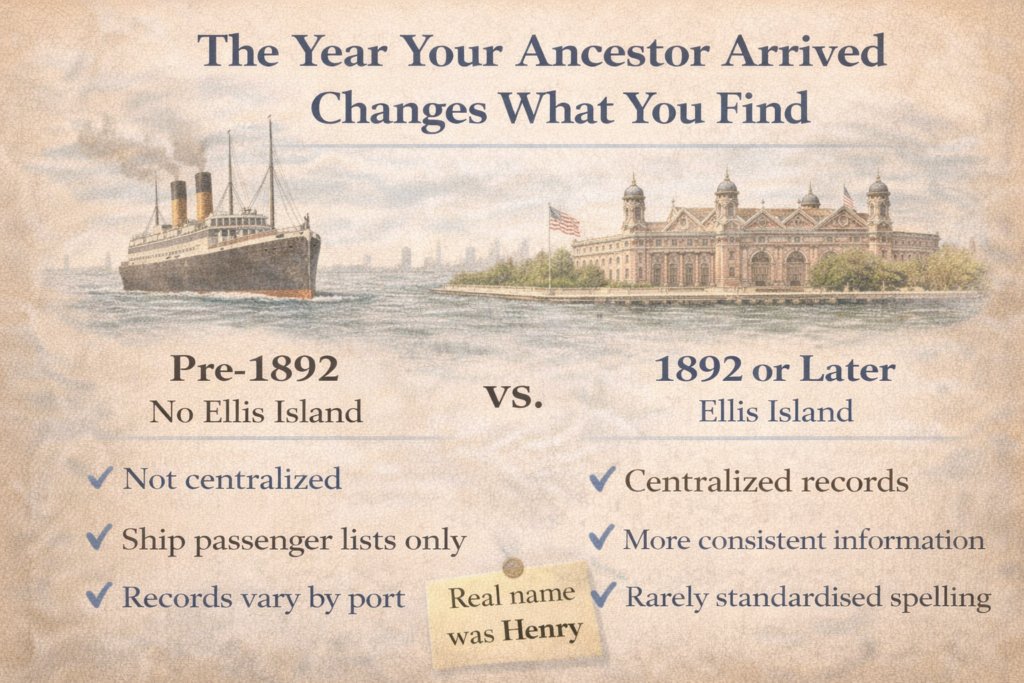
Why the Year Your Ancestor Arrived Completely Changes What You Can Find
Two researchers are both looking for a great-great-grandmother who immigrated from Italy. One finds a passenger record with her name, age, occupation, last residence, the name of her husband already waiting in Brooklyn, the address of the relative she left behind in Calabria, her height, eye color, and the $18 she carried in her pocket. The other finds only a name and an age. The difference between these two experiences is not luck. It is the year the ancestor arrived — and understanding why that matters is one of the most important things any genealogist can know.
Ship Manifests Were Not Always What They Are Now
When most people picture a ship manifest — the passenger list that recorded immigrants arriving in America — they imagine the rich, detailed Ellis Island records that have been digitized and made searchable online. Those records are extraordinary. But they represent only one era of immigration record-keeping, and they are not typical of what survives across the full sweep of American immigration history.
The information collected on passenger manifests changed dramatically over time, driven by changing laws, changing concerns about who should be admitted, and changing administrative capacity. An ancestor who arrived in 1855 left behind a fundamentally different type of record than one who arrived in 1905 — and understanding those differences is essential for knowing what to search for and what to expect when you find it.
Before 1820 — Almost Nothing Survives
Before 1820, the federal government did not require ships to file passenger lists at all. Ships kept their own records for customs purposes, but these were inconsistent, often incomplete, and have survived only in fragments. If your ancestor arrived before 1820, a passenger record may simply not exist.
For ancestors in this era, the research strategy shifts entirely away from immigration records and toward the documents that were being kept in the communities where they settled — church baptism and marriage records, land grants and deeds, tax lists, and colonial census records. These can sometimes trace a family’s presence in America even when no arrival record survives.
1820 to 1890 — The Basics, and Not Much More
The Steerage Act of 1819 created the first federal requirement for passenger lists, and from 1820 onward a record was supposed to be filed for every arriving ship. These customs lists are a significant step forward — and millions of them survive and have been digitized. But they recorded surprisingly little.
A typical 1850s manifest gives you the passenger’s name, age, sex, occupation, and country of origin. That is genuinely useful — especially the country of origin, which in this era often reflected the specific German state or Irish county rather than just a broad national identity. But there is no hometown, no contact in America, no family member back home, no physical description. You have enough to confirm you found the right person, but not enough to learn much about their life.
1891 to 1906 — The First Great Expansion
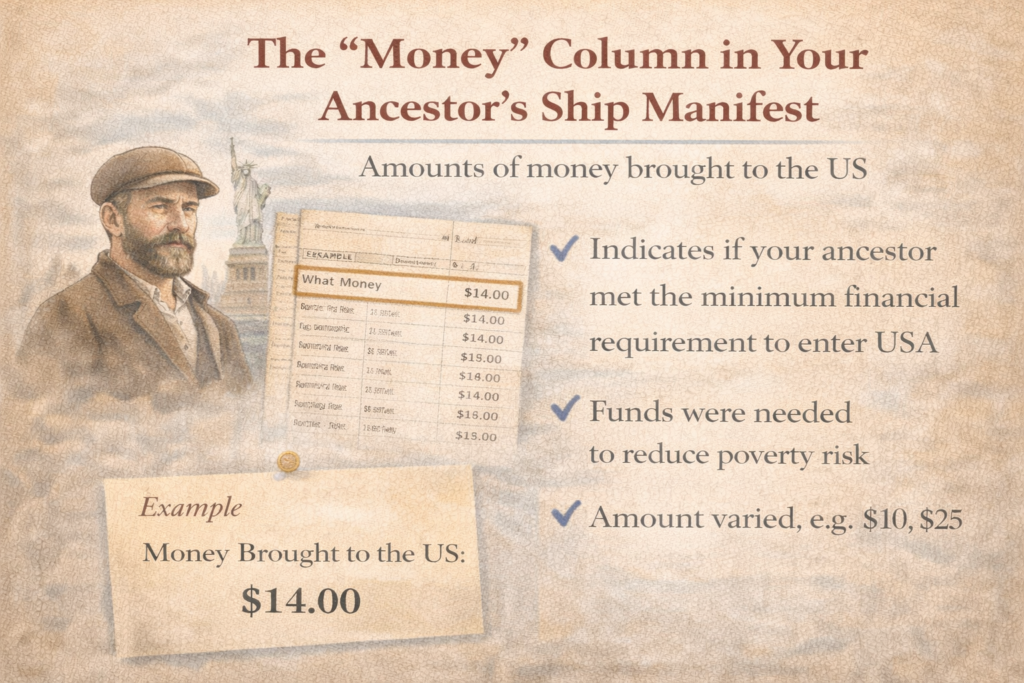
The Immigration Act of 1891 transformed what manifests recorded. For the first time, inspectors were specifically screening immigrants who might become dependent on public support — and the new questions reflect that shift. Manifests from this era record marital status, last residence, final destination in the US, who paid for the passage, how much money the immigrant carried, and basic health information.
Last residence is the breakthrough field of this era. For the first time, a manifest might tell you not just that your ancestor came from Italy but that they came from a specific town in Calabria. That town name is your entry point into Italian civil records, church records, and land records. Before 1891, finding the specific hometown required detective work through other records. After 1891, the manifest often just tells you.
1907 to 1918 — The Golden Records
If your ancestor arrived between 1907 and 1918, you may have won the genealogical lottery. These manifests recorded 29 columns of information — and the additions made in 1907 include the single most valuable field in the entire history of immigration record-keeping.
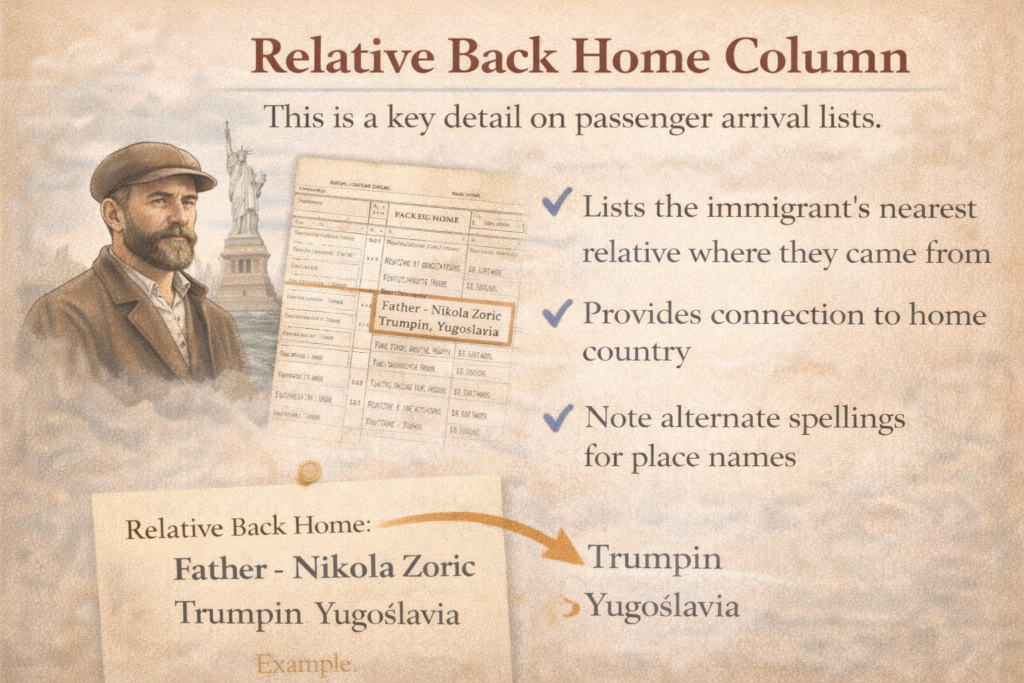
In 1907, manifests began recording the name and full address of the nearest living relative the immigrant was leaving behind in their home country. A parent. A sibling. A spouse. Someone still living in the village, with a name and an address, recorded on an American government document. That relative is your direct connection to European records — a named person in the old country who will appear in church registers, civil records, and land documents that can take your research back generations further.
1919 to 1924 — The Final Years Before the Door Closed
After the First World War, immigration surged again and manifests expanded to 33 columns. These are extraordinarily detailed records — but this era ended abruptly when the Immigration Act of 1924 imposed strict national quotas that reduced immigration to a fraction of its previous volume.
The post-war manifests have one additional advantage for researchers: the new national boundaries drawn after the war’s end mean that countries previously swallowed by empire now appear by name. A Lithuanian immigrant who in 1910 was recorded as Russian appears in 1920 as Lithuanian. A Polish immigrant recorded as German or Austrian before the war appears simply as Polish after it. The geography finally matches the identity.
How to Use This for Your Research
Before you search for a passenger record, establish when your ancestor arrived. The US census is your best tool — the 1900, 1910, and 1920 censuses all ask for the year of immigration. Once you know the approximate arrival year, you know which era of manifest to expect and what fields that record is likely to contain.
If your ancestor arrived in the 1907–1918 window, search specifically for the relative-back-home column once you find the record. It is on the right-hand page of a two-page manifest and is often overlooked by researchers who find the name on the left page and stop there. Turn the page. The most important information may be on the right.
Ellis Island and FamilySearch both have the full two-page manifests available as images. When you find your ancestor, always view the full image rather than relying on the indexed fields — indexers sometimes miss or misread columns, and the image itself may contain handwritten annotations, corrections, or additional notes not captured in the database index.
See exactly what your ancestor’s manifest era recorded
Our Ship Manifest Column Decoder shows you every field collected in your ancestor’s arrival era — and explains what each one can tell you about their life and where to search next.