What the Money Column in Your Ancestor’s Ship Manifest Actually Reveals
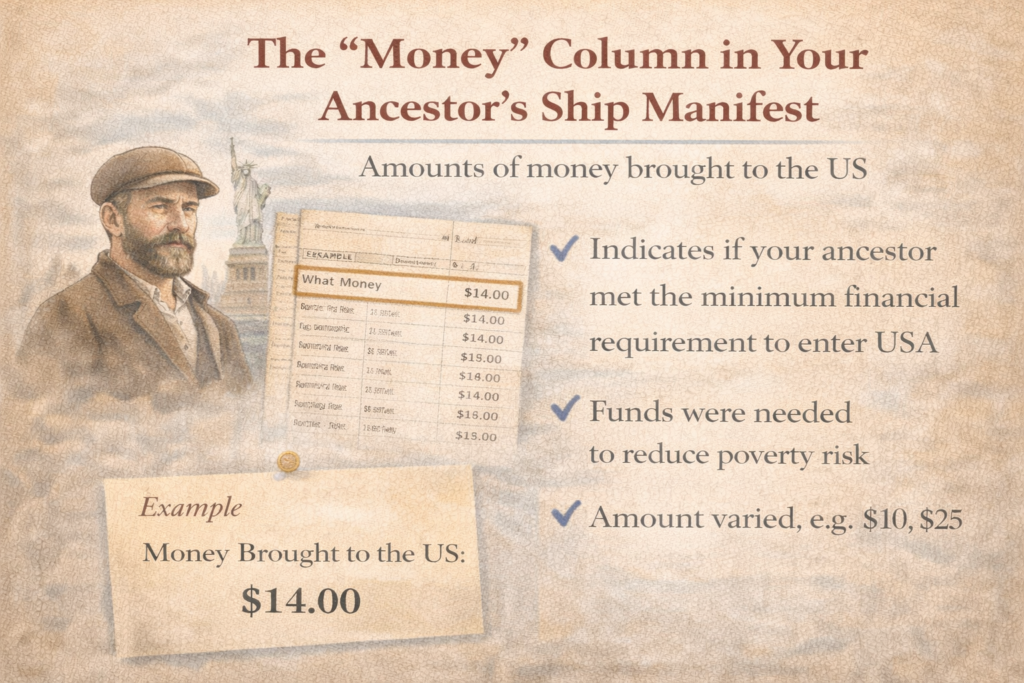
Somewhere on your ancestor’s ship manifest is a column recording how much money they carried when they stepped off the ship. It might say $12. It might say $30. It might say $0. That number is not just a financial detail. It is a measure of desperation, of hope, of how close your ancestor came to being turned away at the door — and it tells you more about the circumstances of their crossing than almost any other single field in the record.
Why the Government Cared About Money
Immigration inspectors at Ellis Island and other ports were not just counting arrivals — they were screening for people who might become dependent on public support. The law excluded anyone deemed “likely to become a public charge,” and the most immediate test of that likelihood was simple: how much money did you bring?
The amount required was never written into law as a fixed number, which gave inspectors considerable discretion. In practice, the informal threshold fluctuated between $25 and $50 depending on the era, the inspector, and what the immigrant said about their plans. Someone who could name a relative already established in America who would support them needed less money. Someone arriving alone with no contacts needed more.
The money was not just declared — it was shown. At the inspection desk, the immigrant opened their purse or their pocket and demonstrated that the cash existed. An inspector who suspected inflation of the amount could ask them to count it out. The money was real, and it had to be there.
What Different Amounts Tell You
A large amount of money — $50 or more — in the manifest of a steerage passenger is a signal worth investigating. Steerage passengers were working class immigrants who had saved for months or years to pay their fare. Arriving with substantial cash suggests either that they were unusually prosperous by the standards of their community, that someone had sent money to fund the crossing, or occasionally that they had borrowed or pooled money from relatives specifically to pass the inspection threshold.
A very small amount — $5 to $15 — tells a different story. This was a family that had scraped together every penny for the ticket and arrived with almost nothing. The crossing itself had cost them everything they had. They were depending entirely on relatives or community connections in America, and they knew it. An amount this small would have drawn scrutiny from inspectors, and the record may show additional questioning or a note about their plans for support.
Zero dollars is the most striking entry of all. It does not necessarily mean the person was penniless — it sometimes means they misunderstood the question, that their money was held by a traveling companion recorded elsewhere on the manifest, or that they genuinely arrived with nothing and were counting entirely on the person meeting them at the dock. Any zero entry should be read alongside the rest of the record for context.
Who Paid the Passage — and Why It Matters
Closely related to the money column is the field recording who paid for the crossing. The options were typically self, a relative already in America, or a third party. Each answer carries different implications.
Self-paid passages indicate an immigrant who had saved independently — someone with enough economic agency to fund their own journey. A relative-paid passage indicates a chain migration pattern, where one family member established themselves in America and then sent money to bring others. This is an extremely common pattern and the person who paid the fare is almost certainly findable in earlier American records.
Third-party payment was viewed with suspicion by immigration authorities. The Foran Act of 1885 made it illegal to import contract laborers — workers who had been promised jobs in exchange for having their passage paid. An immigrant whose passage was paid by an employer or labor agent was potentially in violation of this law and could be denied entry. Most immigrants knew this and stated that they had paid their own fare even when the reality was more complicated.
What Immigrants Brought Besides Money
Steerage passengers were limited in what they could bring. Space in the ship’s hold was shared and strictly controlled — each passenger was typically entitled to a single trunk or chest, with size limits that varied by shipping line. Within that trunk, they carried everything they had chosen to bring from an entire life.
Documents were carried carefully — birth certificates, marriage records, religious papers, sometimes land deeds. Tools of a skilled trade — needles and thread for a tailor, small tools for a craftsman. Family photographs, which by the late 19th century were affordable enough that working-class families had them. Religious objects — a rosary, a prayer book, a mezuzah. Seeds from a kitchen garden. A piece of embroidery made by a mother who was staying behind.
The trunk itself was often the most valuable single object the family owned. In many immigrant communities, old trunks — battered, painted, with faded shipping labels and worn brass hardware — survived in attics and basements long after everything else from the crossing was gone. If your family has such a trunk, it may be older than anyone realizes.
If you find a surprisingly high or low amount in the money column, cross-reference it with who paid the passage, whether the immigrant was joining someone in America, and whether there is a note about additional screening. An immigrant with very little money but a named contact and a specific destination address was in a much stronger position than one with slightly more money and no connections — inspectors assessed the whole picture, not just the cash amount.
The Number That Determined Everything
Your ancestor stood at an inspection desk on a day that changed everything about your family’s history. They opened their pocket. They showed what they had. An inspector looked at the amount, looked at the record, looked at them, and made a decision.
The number in the money column is the number that was there on that day. It is the margin between admission and deportation, between the life your family had in America and the life they would have had somewhere else. It is a small number in a small column in a very old document — and it is one of the most human details that record contains.
Decode every column in your ancestor’s ship manifest
Our Ship Manifest Column Decoder explains what every field means across every era of immigration records — including the money column, who paid the passage, and what different amounts typically indicate.