The Chalk Marks — What the Health Columns in Your Ancestor’s Ship Manifest Really Meant
As the crowded lines of immigrants wound through the Great Hall at Ellis Island, doctors in uniforms stood at the sides watching. They were doing something that sounds almost impossible — assessing the health of thousands of people a day by observation alone, in seconds, as each person walked past. And when they saw something concerning, they did something that would follow that person for the rest of their journey through the building: they stepped forward and marked the immigrant’s clothing with a piece of chalk.
The Six-Second Medical Examination
The Ellis Island medical inspection was not a thorough physical examination for most immigrants. It was a visual scan conducted by US Public Health Service physicians who had been trained to identify signs of disease, disability, or mental illness from outward appearance as a person walked past them in a moving line.
Doctors watched for limps, labored breathing, glazed eyes, skin conditions, unusual posture, or anything that suggested the person might be carrying a condition that would either prevent them from working or make them a risk to public health. They could observe hundreds of people per hour this way — and they were remarkably effective at it, because the conditions they were screening for were often highly visible in the era before effective treatment.
If a doctor spotted something concerning, they placed a chalk mark on the right shoulder of the immigrant’s coat or jacket. The letter indicated what the doctor had observed. The marked person was then directed out of the general line and into a secondary inspection area for a more thorough examination.
🏥 The chalk mark letters and what they meant
What Happened After the Chalk Mark
A chalk mark did not mean automatic deportation. It meant secondary inspection — a more thorough examination by a different doctor, sometimes a specialist, in a quieter room with more time. Many people who received chalk marks passed the secondary inspection and were admitted. The mark was a flag, not a verdict.
But some conditions were automatic bars to entry under US immigration law. Trachoma — a bacterial eye infection that causes scarring and eventual blindness — was one of them. Inspectors at Ellis Island became extraordinarily skilled at identifying trachoma, using a buttonhook to flip the eyelid and examine the inner surface for characteristic granulation. Finding trachoma meant deportation, period, regardless of anything else about the person’s circumstances.
Mental illness was similarly serious. The X mark sent a person to the psychiatric ward for evaluation, and a diagnosis of “idiocy,” “imbecility,” or “insanity” under the terminology of the era meant exclusion. The evaluations were rushed and conducted through interpreters, and there is little doubt that some people were excluded for conditions we would now recognize as treatable or even normal responses to the trauma of the crossing.
How This Appears in the Genealogical Record
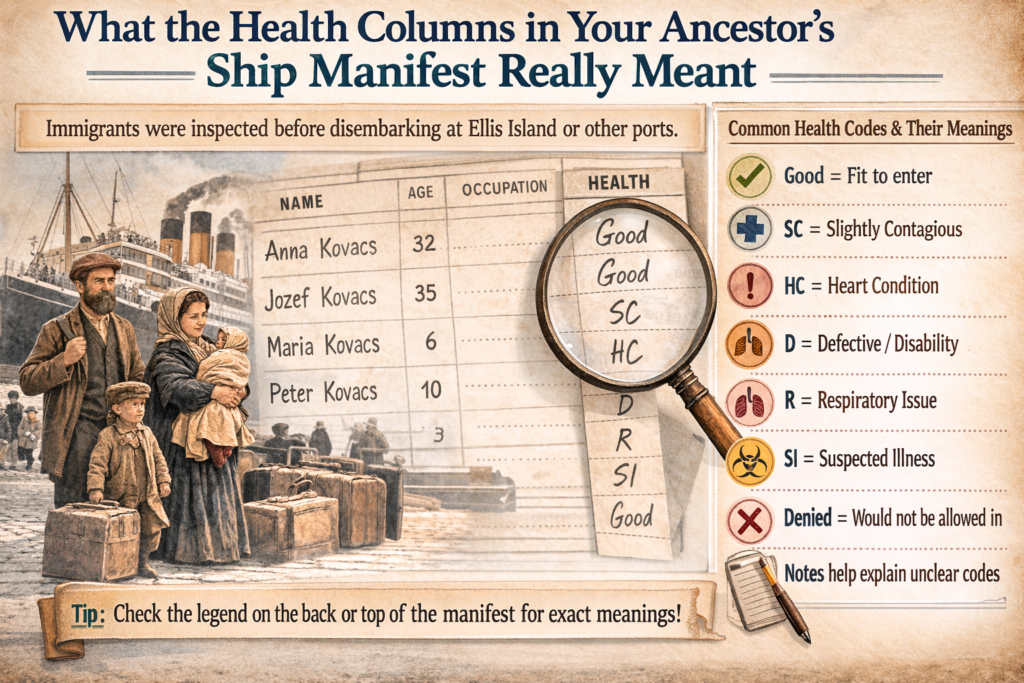
The health examination shows up in passenger manifests in several ways. The manifest itself has columns for physical and mental condition, where the ship’s surgeon recorded their assessment during the voyage. At Ellis Island, additional notations might be added — “S.I.” for special inquiry, indicating the person was held for a board hearing, or stamps indicating detained, admitted, or deported.
If your ancestor was detained, a separate list of detained passengers was kept beginning in 1903. If they appeared before a Board of Special Inquiry — the panel that heard appeals against rejection — a record of that hearing may survive. These detention and inquiry records are less commonly searched than manifests and can contain remarkable detail about an individual’s circumstances.
The Human Cost of the Medical Inspection
The chalk mark system was efficient. It was also, for the people who experienced it, terrifying and dehumanizing. Families who had crossed an ocean together could be separated in seconds when a doctor stepped forward and marked one of them. A mother marked for trachoma while her children were healthy faced the possibility of being sent back while her family was admitted. A father marked for lameness faced the judgment that he could not work.
Some families chose to return together rather than separate. Some were separated permanently — the healthy members admitted to America, the marked member deported to Europe, a division that the subsequent wars and upheavals of the twentieth century sometimes made permanent. These separations are rarely documented in American records because the deported family member simply disappears from the American record trail. Knowing the chalk mark system existed at least explains why.
If you find a ship manifest for your ancestor but cannot locate them in subsequent American records, look carefully at the manifest for any annotations, stamps, or notations beyond the standard printed fields. “S.I.” in the margin means Special Inquiry. “Deported” stamped in red means they were sent back. A line through the name sometimes means they did not board or were removed. These notations are often the only record of what happened to someone who seems to vanish after arrival.
See what health columns your ancestor’s manifest recorded
Our Ship Manifest Column Decoder explains every field in every era of immigration records — including the health and screening columns that determined who got through the door.