What Did Your Ancestor Actually Carry on the Ship — And Could That Old Trunk Have Made the Crossing?
In an attic or a basement, in families with immigrant roots, there is often an old trunk. Battered and paint-worn, with brass hardware gone green and a lock that hasn’t opened in decades. The family story says it came over on the ship. Maybe it did. Maybe it didn’t. But understanding what immigrants were actually allowed to bring — and how to read the clues in an old trunk — can bring you surprisingly close to an answer.
What Steerage Passengers Were Allowed to Bring
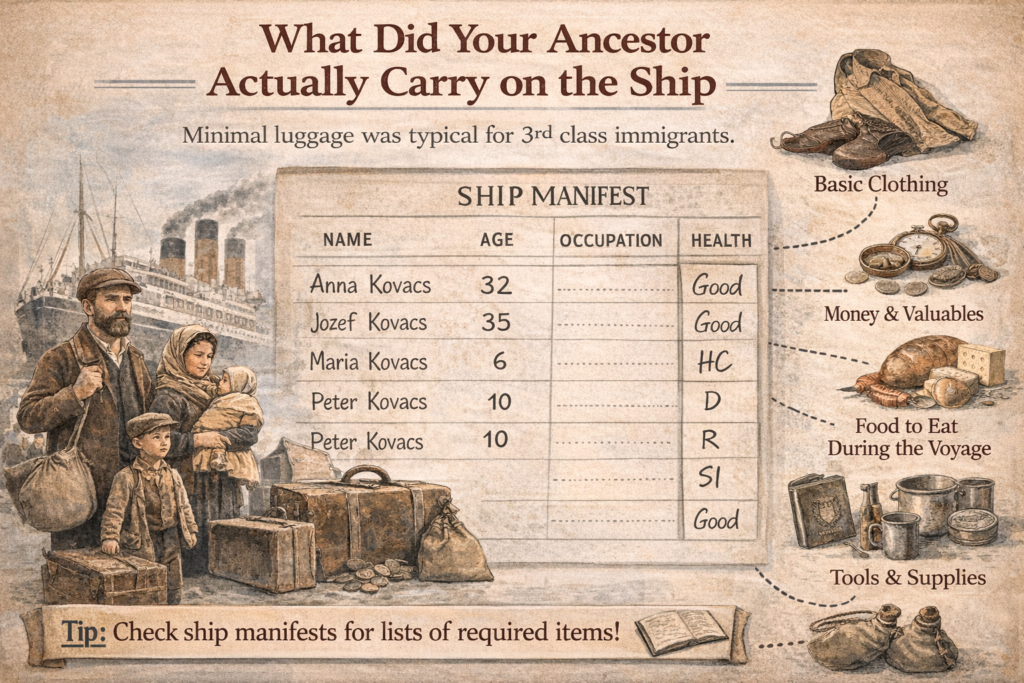
The overwhelming majority of immigrants crossed in steerage — the cheapest class of passage, in the lower decks of the ship where conditions were crowded and basic. Steerage passengers were allowed to bring personal luggage, but the amount and size were strictly controlled by the shipping lines, which had a financial interest in maximizing the number of passengers and a legal interest in keeping the hold manageable.
The standard allowance for a steerage passenger was a single trunk or chest, plus small hand luggage. The trunk had to fit within the space assigned to each berth — roughly the space under a narrow bunk. Size limits varied by shipping line and era, but a typical immigrant trunk was approximately 24 to 36 inches long, 14 to 20 inches wide, and 14 to 18 inches deep. Larger trunks were sometimes allowed in the hold as cargo at additional cost, but most immigrants traveled with what they could carry themselves.
First and second class passengers could bring considerably more — multiple trunks, hat boxes, dress cases. The manifest sometimes records baggage class separately. If your ancestor was in steerage, the trunk was their entire world, packed into a space about the size of a large modern suitcase.
What People Actually Packed
What went into the trunk was the product of an agonizing set of choices. You were leaving everything and could take almost nothing. What mattered most?
Documents came first for most families — birth certificates, marriage records, baptism papers, land deeds, military discharge papers, anything that proved identity or established rights. Immigrants who arrived without documentation faced difficult questions from inspectors and uncertain legal status in America. Papers that could prove who you were and where you came from were worth protecting even at the cost of leaving other things behind.
Tools of a skilled trade were carefully chosen. A tailor’s good scissors. A cobbler’s lasting pliers. A carpenter’s marking tools. These objects were both practically valuable and identity-defining — they told you and the world what you were, what you could do, and what you would become in the new country.
Family photographs, by the late nineteenth century, were affordable enough that working-class families had them — portraits taken at a studio for a special occasion, or informal photographs of parents and grandparents who would not be making the crossing. These photographs were sometimes the only images of family members the immigrants would ever see again.
Religious objects traveled with almost every family regardless of faith. A Catholic family packed a rosary, a prayer book, a small holy image. A Jewish family packed a prayer shawl, a siddur, a mezuzah. A Lutheran family packed a Bible. These were the objects that connected people to the faith they were carrying into an unknown future.
How to Date an Old Trunk
If your family has a trunk that might have made the crossing, there are physical features that can help you estimate when it was made. No single feature dates a trunk precisely, but several features together can narrow the range significantly.
🧳 Features that help date an old trunk
Regional Trunk Styles
Trunks were made differently in different countries, and some regional styles are distinctive enough to suggest origin. German immigrant trunks — sometimes called “immigrant chests” — were often painted, with decorative motifs in red, green, and black on a dark background. Scandinavian immigrant chests were similarly painted, often with folk art floral designs. Eastern European trunks tended to be plainer, with less decoration and more utilitarian construction.
A trunk with painted decoration in a folk art style is far more likely to have originated in Germany, Scandinavia, or Central Europe than in Ireland or England, where trunks were typically unpainted. If your family has German ancestry and the trunk has painted decoration, the two facts support each other.
Whether It Actually Crossed or Not
The honest answer is that most old family trunks cannot be definitively proven to have crossed the ocean. A trunk might have been made in America by a craftsman from the same region as the immigrant family, or purchased in America to match the style of something left behind. The trunk might be the right age and the right style — and still have been bought at a general store in Pennsylvania in 1885.
But here is the thing that matters more than provenance. Whether or not that trunk crossed the ocean, someone in your family kept it. Through moves and clearouts and generations of change, that object survived because someone thought it was worth keeping. That is its own kind of story — a story about what families hold onto and why, about the objects that carry memory even when the memory itself has faded.
The trunk doesn’t need to have crossed the ocean to be meaningful. It just needs to be yours.
Check the inside of the trunk carefully — not just the bottom, but behind the interior tray, under any lining, and in any small compartments. Immigrants often tucked documents into trunks for safekeeping, and papers sometimes survived inside closed trunks for a century or more. A birth certificate, a ship ticket stub, a letter, even a fragment of newspaper can provide a date or a name that transforms what you know about the object and the family that carried it.
Find out what your ancestor’s ship manifest recorded about their baggage
Some ship manifests recorded baggage class and the number of pieces of luggage an immigrant brought. Our Ship Manifest Column Decoder shows you what your ancestor’s era recorded — and what to look for when you find the record.