Why Your American-Born Great-Grandmother Had to Apply for Citizenship Like an Immigrant
She was born in Ohio in 1885. Her parents were born in Ohio. She grew up American, went to an American school, spoke only English. Then in 1908 she married a man who had emigrated from Germany the year before. And somewhere in the records, if you look, you may find her applying for citizenship in the 1920s — going through a process that should have been completely unnecessary for someone born in this country. What happened to her citizenship? The answer is one of the stranger chapters in American legal history.
The Expatriation Act of 1907
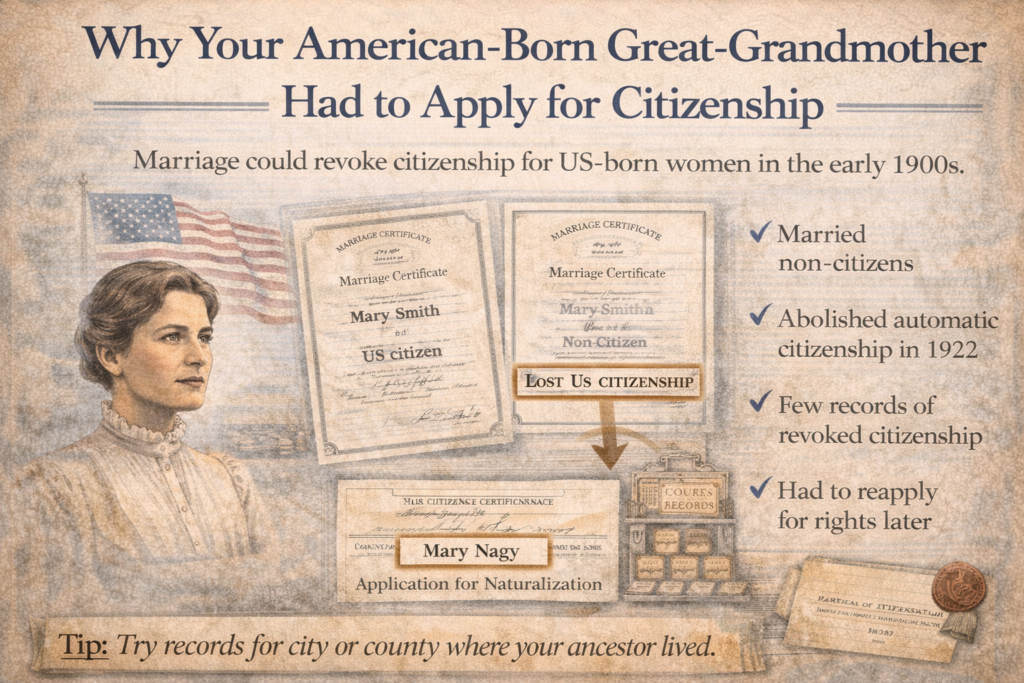
On March 2, 1907, the United States Congress passed the Expatriation Act. Among its provisions was a rule that would affect hundreds of thousands of American women over the next fifteen years: an American woman who married a foreign national automatically lost her United States citizenship at the moment of the marriage.
She did not choose to give up her citizenship. She did not sign any document. She did not move to another country. She simply married a man who was not yet an American citizen, and at that moment she legally became a foreign national — typically acquiring the citizenship of her husband’s home country, whether she wanted it or not, whether she had ever set foot in that country or not.
This was not a fringe interpretation of an obscure law. It was explicit, deliberate, and enforced. The principle underlying it was that a married woman’s legal identity was merged with her husband’s — a doctrine called coverture that ran through American and English common law for centuries. When a woman married, she became her husband’s legal dependent. If he was German, she was German.
What This Looked Like in Practice
An American woman married to a foreign national was, in the eyes of American law, an alien. She could not vote even after the Nineteenth Amendment passed in 1920 — not because of her sex, but because of her citizenship status. She could face deportation during wartime if her husband’s country was an enemy nation. During World War I, American-born women married to German or Austro-Hungarian men were classified as enemy aliens and were required to register with the federal government.
If her husband naturalized, she regained American citizenship automatically — she did not have to file her own papers. His citizenship became hers. But if he died before naturalizing, or if he chose not to naturalize, she remained a foreign national indefinitely, in the country where she was born.
The Cable Act of 1922
The Married Women’s Act — commonly called the Cable Act after its sponsor, Representative John Cable of Ohio — was passed on September 22, 1922. It restored independent citizenship to American women: a woman’s citizenship would no longer be affected by her husband’s status, and American women who had lost their citizenship under the 1907 act could apply to have it restored through a simplified naturalization process.
The restoration process was considerably easier than full naturalization — shorter residency requirements, no witnesses required in some jurisdictions — but it was still a legal process that generated records. Women who went through this process appear in naturalization indexes as applicants, often listing their birthplace as a state rather than a foreign country, which is the detail that signals to a researcher that something unusual is happening.
The Cable Act had an important exception, however. Women who were married to men who were themselves ineligible for citizenship — which under the racial exclusion laws meant men from China, Japan, Korea, the Philippines, and other Asian countries — could not regain citizenship through the Cable Act even after 1922. This exception was not fully resolved until the Immigration and Nationality Act of 1952.
What This Means for Your Research
If you have a female ancestor who was born in the United States but appears in naturalization records, the 1907 Expatriation Act is the most likely explanation. Find out who she married and when. If the marriage occurred between 1907 and 1922, and her husband was not yet a naturalized citizen at the time of the marriage, she lost her citizenship automatically on her wedding day.
The naturalization record she generated in the 1920s is a valuable genealogical document even though it describes someone born in America. It will confirm her name, her birthplace, her address, and her husband’s name and citizenship status. It may also contain personal details — age, physical description — that appear nowhere else.
Women who restored citizenship under the Cable Act process typically appear in naturalization indexes with a birthplace in a US state rather than a foreign country. If you find a naturalization record for a woman born in America, look for a marriage record from between 1907 and 1922 to a foreign-born man. That marriage is the event that put her in the naturalization records. Searching for that marriage may be the most important thing you can do with the naturalization record you found.
Calculate your ancestor’s citizenship timeline
The Naturalization Timeline Calculator includes women’s citizenship rules for every era — including the 1907 Expatriation Act and 1922 Cable Act — so you can understand exactly what happened to your female ancestors’ citizenship status.