Why Your Immigrant Great-Grandmother May Have No Naturalization Papers at All — She Didn’t Need Them
You have your great-grandfather’s naturalization papers — the Declaration of Intention, the Petition, the Certificate. You know your great-grandmother immigrated around the same time he did. But you cannot find any naturalization papers for her anywhere. You’ve searched every database, checked every court. Nothing. Before you conclude that the records were lost, consider a simpler explanation: she may never have filed any, because for most of American history, she didn’t have to.
Derivative Citizenship — The Rule That Erased Women from Naturalization Records
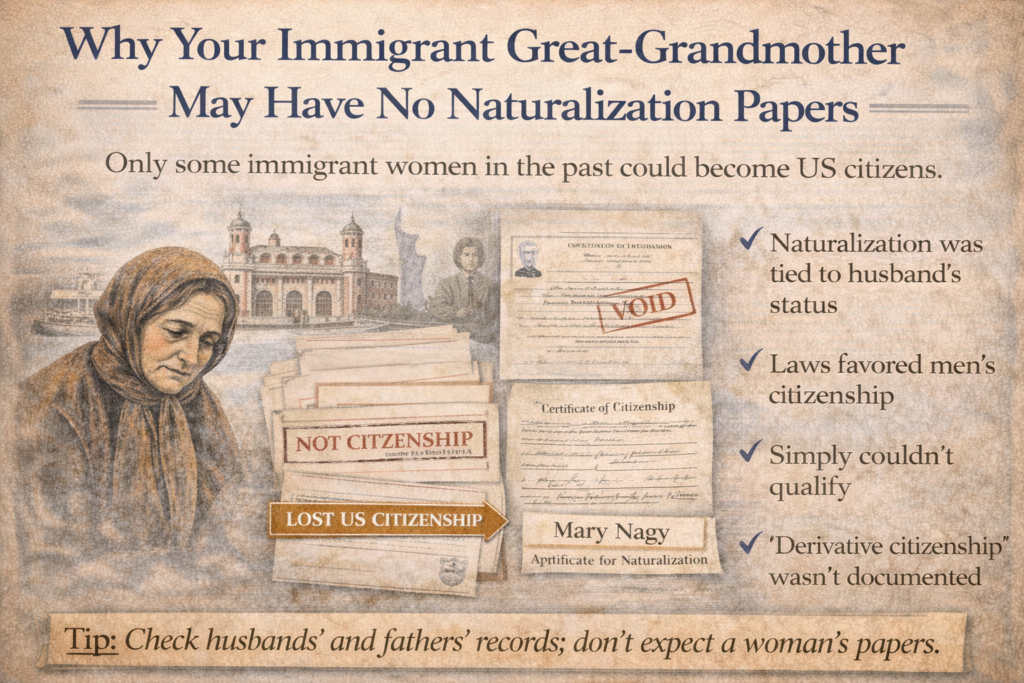
For most of the nineteenth century and into the early twentieth, a married woman did not naturalize independently. When her husband became a naturalized American citizen, she became one too — automatically, by operation of law, without filing any papers and without appearing in any court. This was called derivative citizenship.
Under the Naturalization Act of 1855, a foreign-born woman who was married to an American citizen — either a native-born citizen or a naturalized one — was herself a citizen. She did not need to do anything. The citizenship passed through the marriage. The husband’s papers were her papers.
This rule applied consistently through the early twentieth century. An immigrant woman who arrived in 1890, married an immigrant man who naturalized in 1895, became a citizen in 1895 without setting foot in a courthouse. She will appear in no naturalization index. She generated no Declaration of Intention, no Petition, no Certificate. The only evidence of her citizenship is in her husband’s file, which is not indexed under her name.
What This Means for the Census Records
In the 1900, 1910, and 1920 censuses, naturalization status was recorded for every person over a certain age. A married immigrant woman whose husband had naturalized should appear as NA — naturalized — even though she never filed any papers. If she appears as AL — alien — when her husband is recorded as NA, one of several things may have happened: the census enumerator made an error, the husband had not yet naturalized at the time the census was taken, or the woman had married after her husband’s naturalization and the enumerator applied the rules inconsistently.
Census enumerators were not always precise about the rules governing derivative citizenship, and the records reflect that inconsistency. An NA woman in the census whose husband naturalized is following the law correctly. An AL woman in the census whose husband is NA may simply be a recording error.
Children Followed the Same Rule
Minor children were also covered by derivative citizenship. When a father naturalized, his minor children who were residents of the United States became citizens automatically. Daughters who were minors when their father naturalized would have no naturalization papers, yet they would appear as NA in later census records. Sons who naturalized as adults — after they had aged out of being covered by their father’s naturalization — would have their own papers. The difference in what records exist for children of the same family often comes down to whether they were minors when their father finalized his citizenship.
When Women Did Need Their Own Papers
After the Cable Act of 1922, women who married after that date had independent citizenship status — their citizenship no longer changed automatically with their husband’s. Women who married after September 22, 1922 and wanted to naturalize had to go through the process themselves.
Women who had lost citizenship under the 1907 Expatriation Act — American-born women who had married foreign nationals — could restore their citizenship through a simplified process under the Cable Act, and those proceedings generated records.
And women who arrived after 1922 as single immigrants, or who arrived and remained unmarried, naturalized independently and generated their own full naturalization files.
If your immigrant female ancestor arrived before 1922 and was married, look for her citizenship in her husband’s naturalization file rather than in a file under her own name. His Certificate of Naturalization sometimes lists the names of family members who derived citizenship through it. His Petition for Naturalization sometimes lists his wife and children. If you can identify the husband’s naturalization date and confirm he naturalized before 1922, you have effectively confirmed her citizenship status too — even without finding any document in her name.
See how citizenship rules applied to your female ancestors
The Naturalization Timeline Calculator includes the full history of women’s citizenship law — derivative citizenship, the 1907 Expatriation Act, and the 1922 Cable Act — so you know exactly what records to look for and why some may not exist.