Why Your Ancestors Almost Always Married Someone From the Same Country — And Why It Wasn’t Just Language
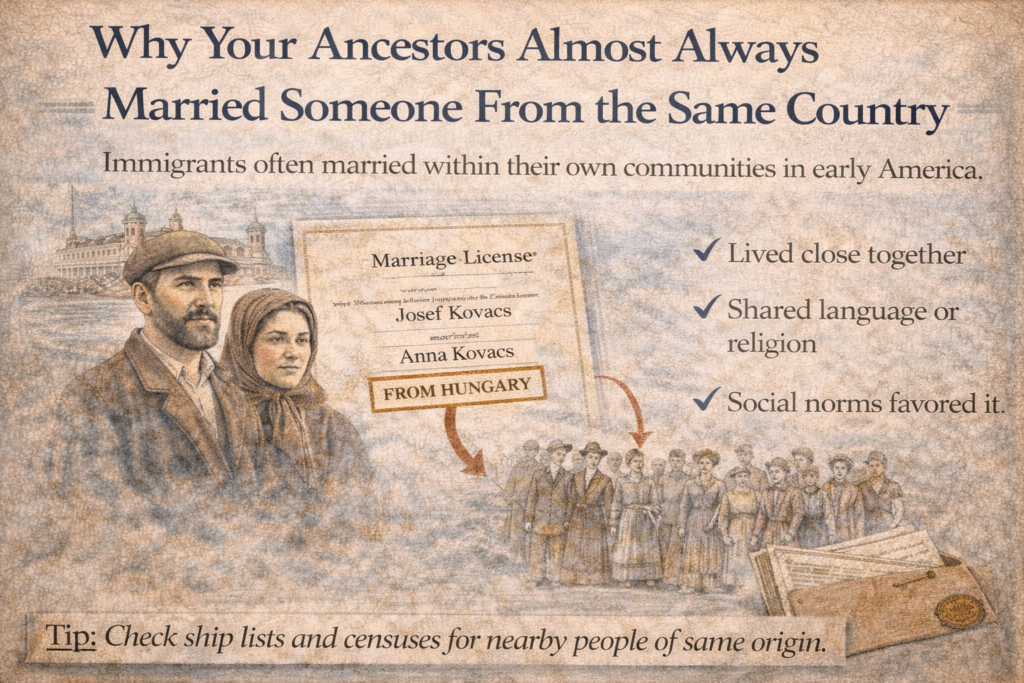
Look at almost any immigrant family tree from the late nineteenth or early twentieth century, and the pattern is nearly universal: German immigrants married Germans, Polish immigrants married Poles, Italian immigrants married Italians. Even immigrants who had been in America for years, who spoke English, who worked alongside people from other backgrounds — when they married, they almost always married someone from home. Researchers often assume this was about language. Language was part of it. But the real story is more complicated, and understanding it can tell you a great deal about where to look for your ancestors’ families.
They Mostly Knew People From Home
The first thing to understand about immigrant marriage patterns is that they were largely a function of who immigrants actually knew. American immigration in this era was not random. It followed chains — one person from a village goes to Pennsylvania, sends back a good report, and over the next decade half the village follows. People settled in clusters. The neighborhood where your ancestor lived was likely populated by people from the same region, the same province, often the same few villages.
When a young immigrant man was looking for a wife, or a young immigrant woman was of marriageable age, the people they spent time with — at church, at work, at the community hall, at the boarding house — were almost all from the same place. They didn’t choose to marry within their group out of insularity. They married within their group because that was almost everyone they knew.
The Church Enforced It
For Catholic immigrants — Irish, Italian, Polish, Slovak, Croatian — the parish was the center of community life, and the parish was almost always ethnically organized. German Catholics went to the German parish. Polish Catholics went to the Polish parish. The priest conducted services in the old language, administered the sacraments in the old language, and kept records in the old language. Marriage within the parish was expected. Marriage outside the parish — let alone outside the ethnic community — was socially complicated and in some communities actively discouraged.
Jewish immigrants were similarly organized around the synagogue, which was not just a religious institution but a mutual aid society, a social community, and a matchmaking network. Marriage outside the faith was rare and often meant effective excommunication from the community that provided the immigrant’s entire support network.
For Protestant immigrants — Germans, Scandinavians, Dutch — the denomination-specific church played a similar role. The congregation was the community. The community was the pool of potential spouses.
Marriage Was Also a Practical Decision
Beyond community and religion, immigrant marriage had a practical dimension that gets lost when we think about it only in terms of cultural preference. In the immigrant economy of the late nineteenth century, marriage was a financial and logistical arrangement as much as a romantic one. A man who married a woman from his own community was marrying into a known family, with known connections, whose relatives could vouch for the woman’s character and background. He was potentially connecting to another household’s labor, savings, and social network.
A woman who married a man from the same ethnic community was marrying someone whose family could be investigated — either directly, through people in the community who knew them, or through letters back home. She was marrying into a network that would support her if anything went wrong. Marrying a stranger from a completely different background meant marrying into the unknown, with no community standing behind the relationship.
What This Means for Following the Chain
The practical consequence of endogamous marriage patterns for genealogical research is that your immigrant ancestors’ spouses almost always came from the same place they did — not just the same country but often the same region, the same province, sometimes the same village. If you know where your great-grandfather came from, there is a strong likelihood that his wife came from nearby.
This means that when you are trying to identify where an immigrant family originated, you can sometimes triangulate from both sides. If you know the husband came from Bavaria and you know the wife was from the same area based on the names of her family members or the church records they used, you have narrowed the search considerably. Chain migration also means that your ancestors’ siblings likely came to the same place — which means your great-grandfather’s brother-in-law may be in the same city directory, the same census page, the same church records, and his naturalization papers may contain the village name that your great-grandfather’s papers never recorded.
When you identify your immigrant ancestor’s spouse, treat the spouse as a research subject in their own right. Find her ship manifest, her family in the census, her parents’ names in a marriage record. Her family very likely came from the same region as your ancestor. Tracing her family backward may lead you to the village of origin for both families — and sometimes the two families turn out to have been neighbors in the old country before they were neighbors in Pennsylvania.
Understand the full picture of your ancestor’s immigration
Our tools help you read the records your ancestors left — from the ship manifest that brought them here to the naturalization papers that made them citizens.