
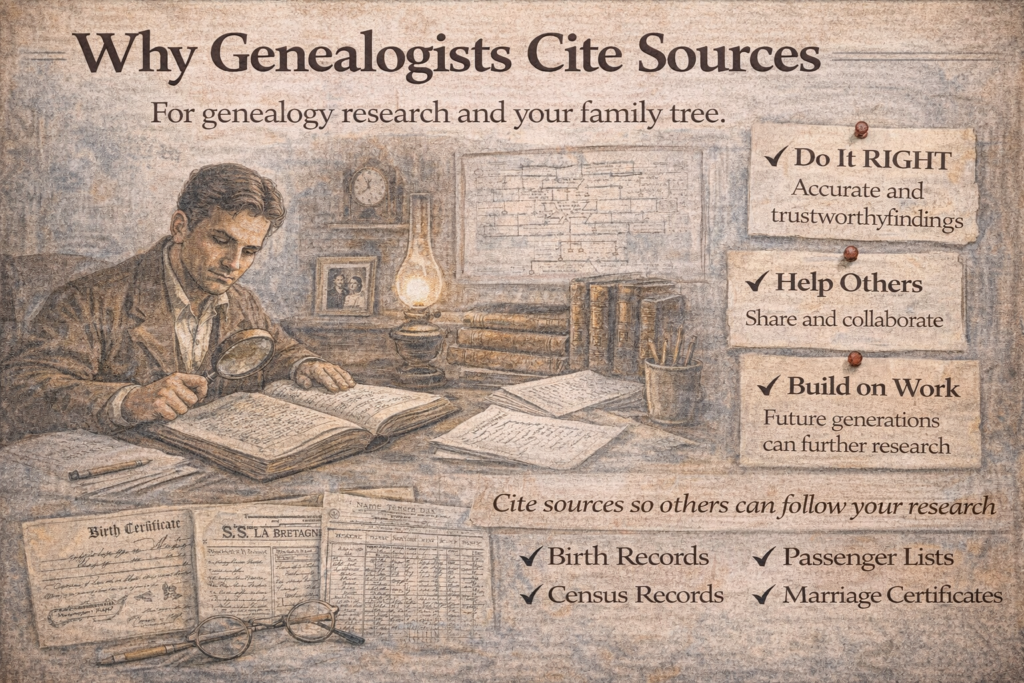
Why Genealogists Must Cite Every Source, Even When It Feels Like Overkill
You found a name. You found a date. You found a place. And you were so excited that you added it straight to your tree without writing down where it came from. Three months later, you cannot remember whether that birth date came from a census record, a family bible, or your second cousin’s email. It happens to everyone — and it is the single most damaging mistake in genealogy research.
The Moment It All Falls Apart
Here is what happens when you do not cite your sources. You build a tree. You spend months — maybe years — adding names and dates and places. The tree looks impressive. It grows into something you are genuinely proud of. And then one day you discover a conflict. Two records give two different birth years for the same person. One says 1847, the other says 1851. You know you have seen both dates before, but you cannot remember which record said which.
Without a citation, you cannot go back and evaluate the records. You cannot ask the questions that matter: was the 1847 date from a record created near the time of the event, or from a death certificate filled out sixty years later by a son-in-law who was guessing? Was the 1851 date from a census record where the enumerator estimated ages, or from a church baptismal register made the same week the child was born?
The answers to those questions determine which date is more likely to be correct. But without citations, you will never know. You are left guessing — which is exactly what you were trying to stop doing when you started this research in the first place.
A Citation Is Not Busywork
Many people treat source citations like homework — something tedious that a teacher requires but nobody actually uses. In genealogy, this could not be more wrong. A citation is not a formality. It is a map back to the evidence. It tells you — and anyone who reads your research after you — exactly where to find the original record so they can see it with their own eyes and make their own judgment about what it says.
This matters because genealogy is not just about collecting names. It is about building a case. Every ancestor you identify, every relationship you establish, every date you accept as accurate is a conclusion based on evidence. If you cannot point to the evidence, the conclusion is worthless — no matter how confident you feel about it right now.
What Happens When You Share Uncited Research
The genealogy internet is full of trees that have been copied from other trees that were copied from other trees. Somewhere at the beginning of that chain, somebody probably looked at an actual record. But by the time the information reaches you, it has been copied so many times that nobody knows where it originally came from. Errors that were introduced at any point in the chain — a misread date, a confused generation, a wrong spouse — have been duplicated into hundreds of trees, where they look like confirmed facts simply because so many people have the same information.
This is not a small problem. It is the single biggest source of error in online genealogy today. And the only thing that breaks the chain is a citation. When you cite your sources, anyone who encounters your research can trace it back to the original record and verify it. When you do not, your research becomes part of the noise — another unchecked tree adding to the echo chamber.
You Do Not Need to Be Perfect
Here is the good news: citing your sources does not require you to memorise a complicated format or spend twenty minutes composing each citation by hand. What matters is that you record enough information for someone to find the same record again. The name of the person in the record. The type of record. Where you found it. The date on the record. The repository or website.
If you write down those five things every time you look at a record, you are doing better than most genealogists. A formal citation in Evidence Explained format is ideal — and generators exist that can format it for you — but an imperfect citation that gets you back to the record is infinitely better than no citation at all.
Every time you find a record, before you add anything to your tree, write down: (1) what the record is, (2) whose name is on it, (3) where you found it, (4) what date the record was created, and (5) the URL or repository. That is your citation. You can always format it properly later.
The Real Reason to Cite
The deepest reason to cite your sources is not about following rules or impressing other genealogists. It is about respecting the people you are researching. Every name in your tree was a real person who lived a real life. The records that survive them — a census line, a ship manifest entry, a death certificate — are the last traces of that life. When you cite the record, you are preserving the connection between the person and the evidence of their existence. When you do not, that connection is lost — maybe not today, but eventually, when your tree passes to someone who cannot ask you where the information came from.
Your future self will thank you. Your children will thank you. And the researchers who come after you — the ones who pick up where you left off and carry the work further back — will be able to do so because you left a trail they can follow.
Generate a proper citation in seconds
Our Source Citation Generator builds formatted citations for census records, vital records, passenger lists, naturalization papers, and 14 other record types — just fill in the blanks and copy.