Why Your Ancestor’s Naturalization Papers List a Different Arrival Date Than the Ship Manifest
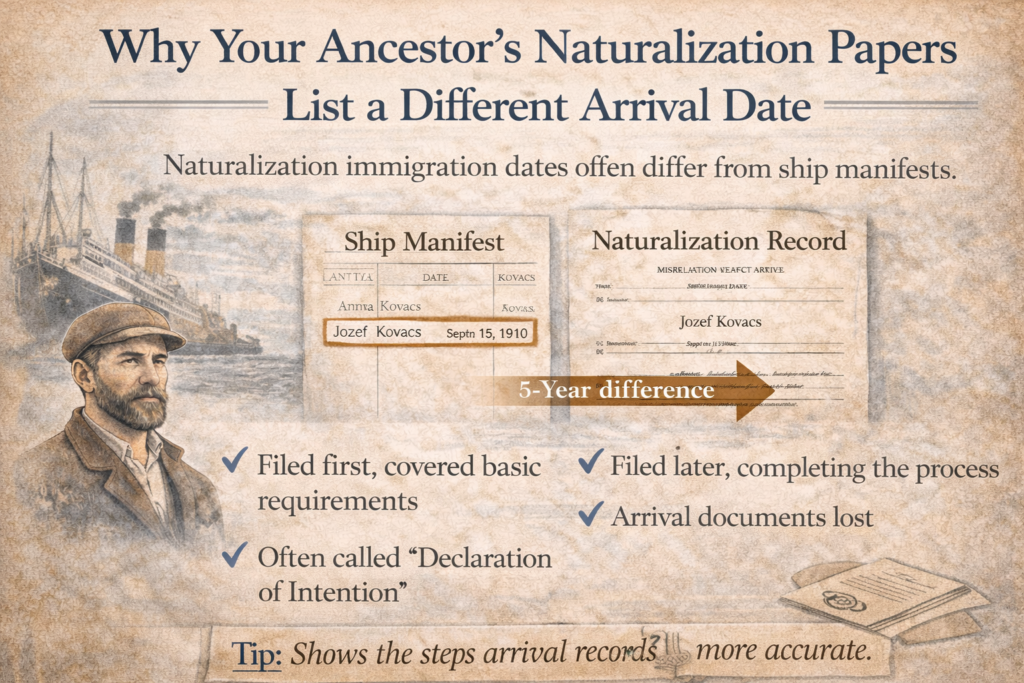
You found your ancestor’s ship manifest. You found their naturalization papers. You expect the dates to match. They don’t. The manifest says 1893. The Declaration of Intention says 1891. Or the manifest says April and the petition says October. Researchers see this constantly and often assume one of the documents is wrong. Usually neither one is. They are both recording the truth — just different truths.
The Immigrant’s First Trip Was Not Always the Last
The most common reason for a date discrepancy is the simplest one: your ancestor crossed the Atlantic more than once. Many immigrants made one or two trips back to Europe before settling permanently in America — to collect a spouse, bring over children left with grandparents, settle the sale of property, or simply visit aging parents they feared they would never see again. The ship manifest you found may be the second arrival, or the third. The naturalization papers record the first.
For the purposes of naturalization, what mattered was when the immigrant first arrived and began accumulating residency. The five-year residency clock started from the first arrival, not the last. An immigrant who arrived in 1888, went back to Poland in 1891, and came back to America in 1892 would have a naturalization petition recording 1888 — but the manifest you most easily found might be the 1892 return. Always search for multiple manifests for the same ancestor before concluding that a date discrepancy represents an error.
Memory Is Not a Filing Cabinet
An immigrant who arrived in 1887 and filed naturalization papers in 1910 was trying to remember an event from twenty-three years earlier. They may have remembered the year correctly but the month wrong. They may have remembered the season but not the year. They may have rounded — choosing a year that felt approximately right but was off by one or two. A person who arrived in late November 1893 might remember it as 1894, because by the time they were settled and oriented it was January.
This was especially common before 1906, when naturalization was handled by local courts with no federal oversight. The court clerk recorded what the immigrant said. No one verified it against the ship manifest. The immigrant’s testimony was the record.
The Ship Manifest Recorded Arrival. Naturalization Papers Recorded Intent.
There is also a subtler difference in what each document was actually capturing. The ship manifest recorded when the ship arrived at port. The naturalization papers recorded when the immigrant considered themselves to have taken up residence in America — which might be a slightly different date.
An immigrant who arrived at Ellis Island on December 28, 1899 might have spent weeks in transit, staying in a boarding house in New York while waiting for enough money to reach a cousin in Pittsburgh. They finally arrived at their actual home in early February 1900. When asked years later when they came to America, they might say February 1900 — the date they arrived at their destination, not the date the ship docked. Both dates are in some sense correct.
Some Immigrants Deliberately Adjusted Their Dates
Not all discrepancies are innocent. Under the 1906 Naturalization Act, the residency requirement was strictly enforced and the federal government was actively looking for fraud. Some immigrants who had arrived after 1906 claimed earlier arrival dates to shorten the waiting period. Some who had left and returned to Europe multiple times strategically chose to report the earliest arrival date possible to maximize their accumulated residency.
This doesn’t mean your ancestor was dishonest. The line between misremembering and strategic misreporting is genuinely blurry when a person is trying to recall an event from years earlier. But it does mean that when a naturalization date is significantly earlier than the manifest date, it’s worth searching for an earlier arrival that would explain it legitimately before assuming fraud.
The Pre-1906 Problem
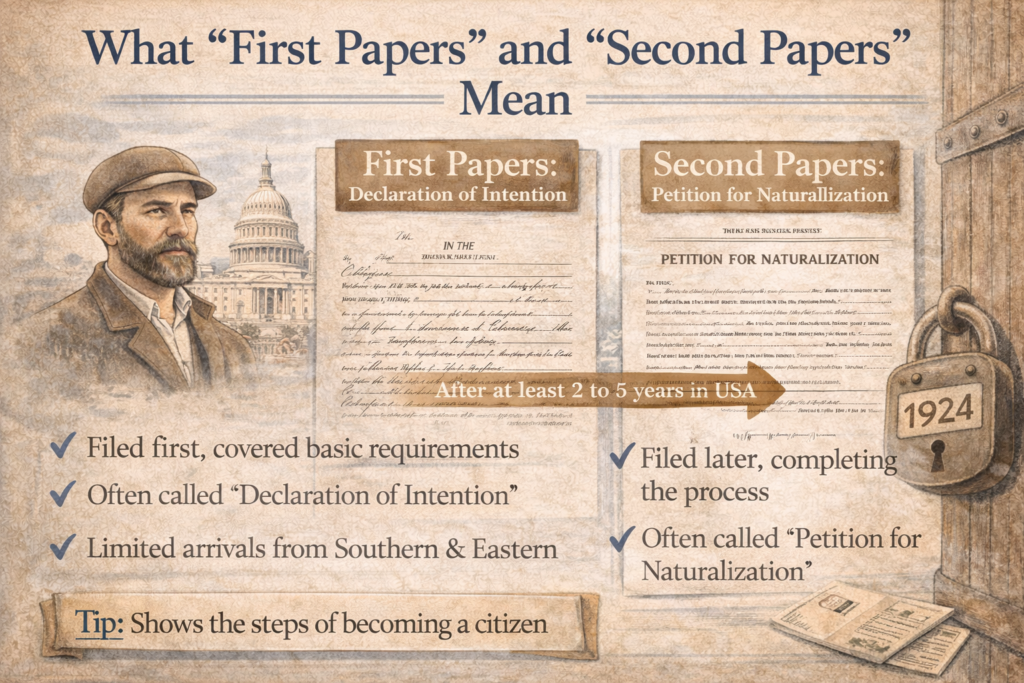
Before September 1906, there was no central registry of naturalizations. Immigrants could naturalize in any court of record — state, county, or federal. Courts did not report to each other. An immigrant could theoretically file First Papers in Ohio and Second Papers in Pennsylvania and no one would know to cross-reference the records.
This also means that the arrival date recorded in a pre-1906 naturalization was never verified against anything. The clerk wrote what he was told. This is both a problem and an opportunity: it means pre-1906 naturalization dates are particularly likely to be approximate, but it also means that a pre-1906 Declaration of Intention may be the only surviving record of an exact arrival date for an immigrant whose ship manifest has not been indexed or has not survived.
When you find a date discrepancy, don’t try to decide which document is “right.” Instead, use both dates as search parameters. Search for ship manifests in both years. Search for immigration records in a two-to-three year window around each date. The goal is to find all the arrivals, not to confirm one date and discard the other. Many researchers have discovered an entire earlier chapter of their ancestor’s American story this way — a first arrival, a return home, a second arrival — that the family never knew about.
Understand your ancestor’s full naturalization timeline
The Naturalization Timeline Calculator shows you exactly what documents the process generated in your ancestor’s era, where to find them, and what each one typically records.