Why Your Dutch Ancestor’s Surname Was Probably a Joke
Somewhere in the Netherlands in 1811, a farmer stood in front of a government clerk, was asked for his family surname, and replied — with a perfectly straight face — “Naaktgeboren.” Born naked. The clerk wrote it down. The farmer went home satisfied that he had made his point. Two hundred years later, his descendants are still carrying the name. This is the story of how the Dutch got their surnames, why so many of them are ridiculous, and what that means for your genealogy research today.
Before Napoleon: Nobody Had a Surname
For most of Dutch history, ordinary people simply did not have hereditary surnames. They didn’t need them. In a small village where everyone knew everyone, you were Jan the miller’s son, or Pieter who lived by the canal, or Marie from the farm on the hill. That was enough to identify you.
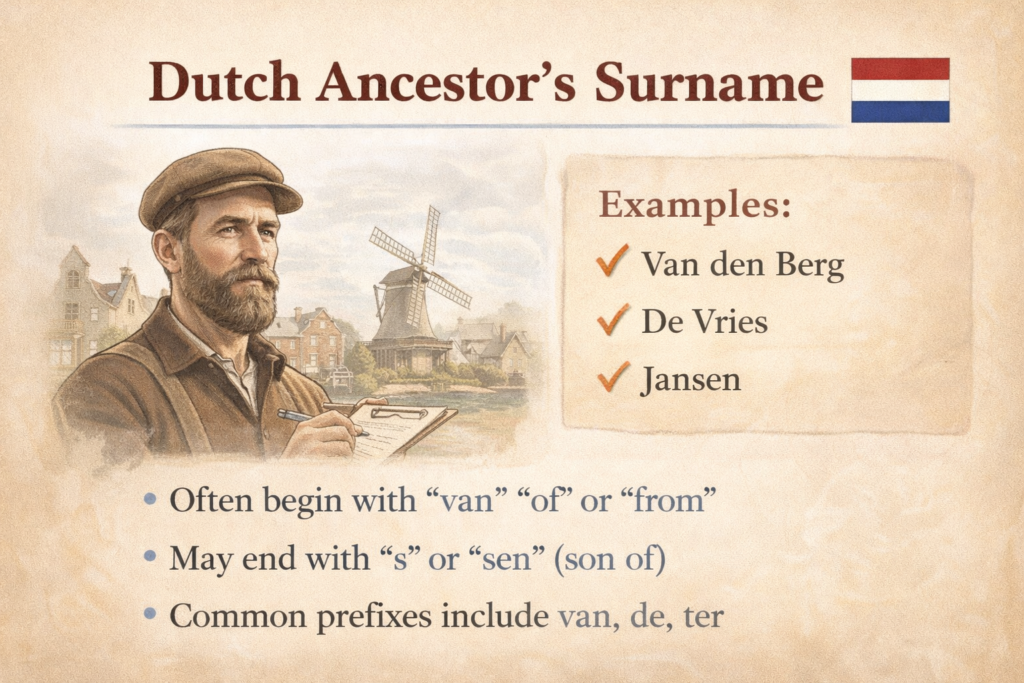
Instead of fixed surnames, the Dutch used a patronymic system — a name that identified whose child you were. If your father was Jan, you were Jansen (Jan’s son) or Jansdochter (Jan’s daughter). If your father was Pieter, you were Pietersen. When you had children of your own, they would take their surname from your name, not from yours. Every generation the surname changed.
This system worked perfectly well for daily life in a stable community. It was, however, an administrative nightmare for anyone trying to keep records across generations — which is precisely why it makes Dutch genealogy research so challenging today, and precisely why Napoleon decided to put a stop to it.
Napoleon’s Order and a Nation’s Stubbornness
In 1811, Napoleon Bonaparte had conquered the Netherlands and incorporated it into the French Empire. One of his first acts of administrative tidiness was to require every Dutch citizen to register a fixed, hereditary family surname. The French had been doing this for centuries. It was time the Dutch caught up.
The Dutch did not take this well.
The Netherlands had a long tradition of resisting foreign authority, and many Dutch citizens viewed the surname registration as yet another unwanted imposition from a foreign conqueror. They were also convinced — incorrectly, as it turned out — that Napoleon’s empire would collapse soon and the whole thing would be forgotten. So they complied with the letter of the law while mocking its spirit entirely.
The Names They Chose
Some Dutch families registered sensible, respectable surnames — names based on their occupation, their village, or a family characteristic. A blacksmith became De Smid. A fisherman became Visser. A family known for being tall became De Groot. These were the names of people who either took the registration seriously or simply lacked the imagination for protest.
And then there were the others.
🇳🇱 Real Dutch surnames registered in 1811
These names were not accidents or typos. They were deliberate choices made by people who were certain the whole registration would come to nothing. Napoleon fell in 1815. The French left. And the Dutch discovered, to their considerable embarrassment, that the new Dutch government intended to keep the surname register entirely intact.
The joke names stayed. They have been staying ever since. Today there are still Dutch families carrying these surnames, many of whom have no idea why their great-great-great-grandmother’s maiden name translates as “born naked.”
What This Means When Your Dutch Ancestor Arrived in America
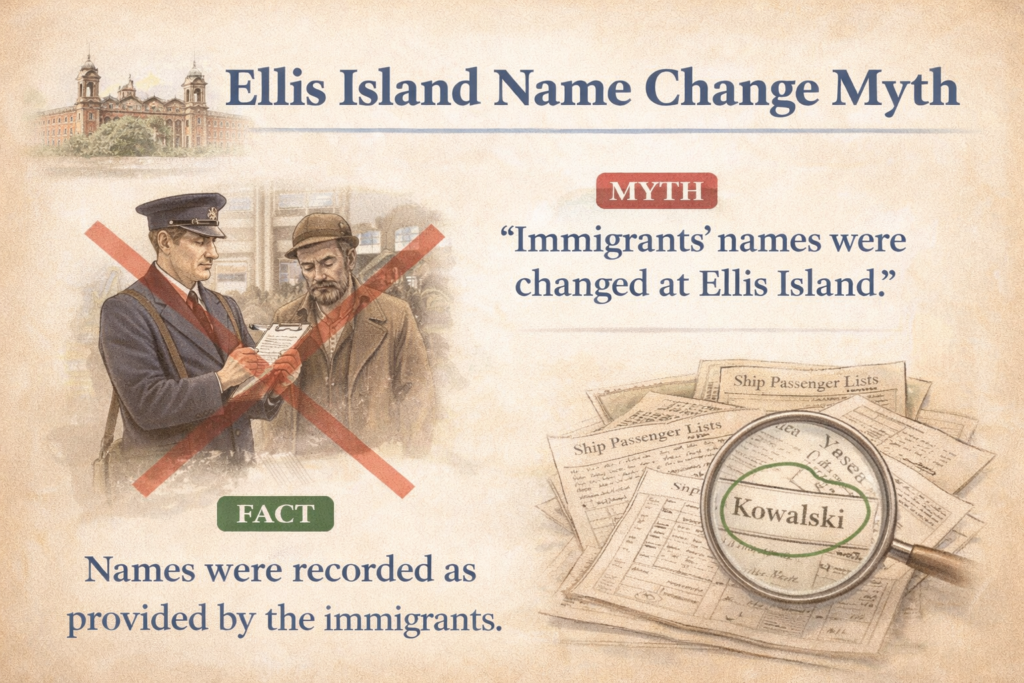
Now imagine one of these names arriving at an American port in 1880. A Dutch immigrant steps off a ship, approaches an immigration clerk, and attempts to pronounce their surname in Dutch — a language the clerk has never heard — while the clerk attempts to write down what they think they heard in English.
Naaktgeboren became Nakeborn, Nakborn, or simply was abandoned entirely for a completely new English name. Zeldenthuis became Seldenhouse or Zeldenhuis or vanished. Springintveld became Springfeld or Springfield or nothing recognisable at all.
Even the more sensible Dutch surnames underwent dramatic transformations. Dijkstra became Dykstra. Van den Berg became Vandenberg or Berg or Vandenbergh. De Groot became DeGroot or Groot or even, occasionally, just Large. Visser became Fisher — which, if you have German ancestry too, creates the exact same surname via a completely different route, which is its own genealogical puzzle.
The Patronymic Names That Slipped Through
Not every Dutch immigrant had a 1811-registered surname. Some families — particularly from more rural or traditional communities — were still informally using the old patronymic system well into the nineteenth century, especially in the province of Friesland where the old ways persisted longest.
A Frisian immigrant might arrive with a name like Pietersen or Jansen that referred to their father’s first name rather than a fixed family surname. Their children in America might use an entirely different surname. Their grandchildren might use another. Tracing these families requires working backwards generation by generation, finding each patronymic and identifying the father’s first name it derived from.
The good news is that Frisian patronymics follow very consistent rules. A name ending in -sen or -sma or -stra is almost always Frisian in origin, and these endings are distinctive enough to identify even when everything else has been anglicised.
How to Trace a Dutch Ancestor When the Surname Has Changed
Start with what you know in America and work backwards. Find your ancestor in the US census, ideally in 1900 or 1910 when immigration year and mother tongue were recorded. Mother tongue listed as Dutch or Flemish is your confirmation. The immigration year gives you the decade to search in passenger records.
In passenger records, search phonetically rather than by exact spelling. Dutch surnames were almost never transcribed accurately by American clerks. Try shorter versions of the surname, try versions with the van/de prefix removed, and try purely phonetic guesses at what a Dutch word might sound like to an English ear.
Once you cross back into Dutch records, remember that before 1811 you are looking for patronymics rather than fixed surnames. The person you find in the 1811 registration may be the first member of your family to carry the surname you are researching — everyone before them will have a different name entirely.
Dutch civil registration began in 1811 — the same year as the surname registration. Before 1811, records were kept by churches, and the Dutch Reformed Church (Nederlands Hervormde Kerk) has some of the most complete pre-civil records in Europe. If your Dutch ancestor was born before 1811, church baptism records are your primary source — and you will be searching for a patronymic, not a fixed surname.
The Surnames That Tell a Story
Here is the thing that makes Dutch surname research uniquely rewarding: because so many surnames were registered in a single year by people who knew exactly what they were doing, the names often contain information. An occupational surname tells you what the family did for a living in 1811. A place-name surname tells you where they were from or where they lived. Even the joke names tell you something — that this was a family with a sense of humour, or a stubborn streak, or a deep distrust of French bureaucracy.
When you find your Dutch ancestor’s original surname, you are not just finding a name. You are finding a moment — a Dutch farmer standing in front of a clerk in 1811, choosing a name that he thought would disappear within a few years, and accidentally giving his entire future family tree something to explain at dinner parties for the next two centuries.
Find what your Dutch ancestor’s name became in America
Our Ancestor Name Bridge tool covers Dutch and Holland name transformations in both directions — find the original Dutch name from the American version, or find all the American variants of a Dutch name you found in a ship log.