What Your Family Forgot to Tell You About How Hard the First Years Actually Were
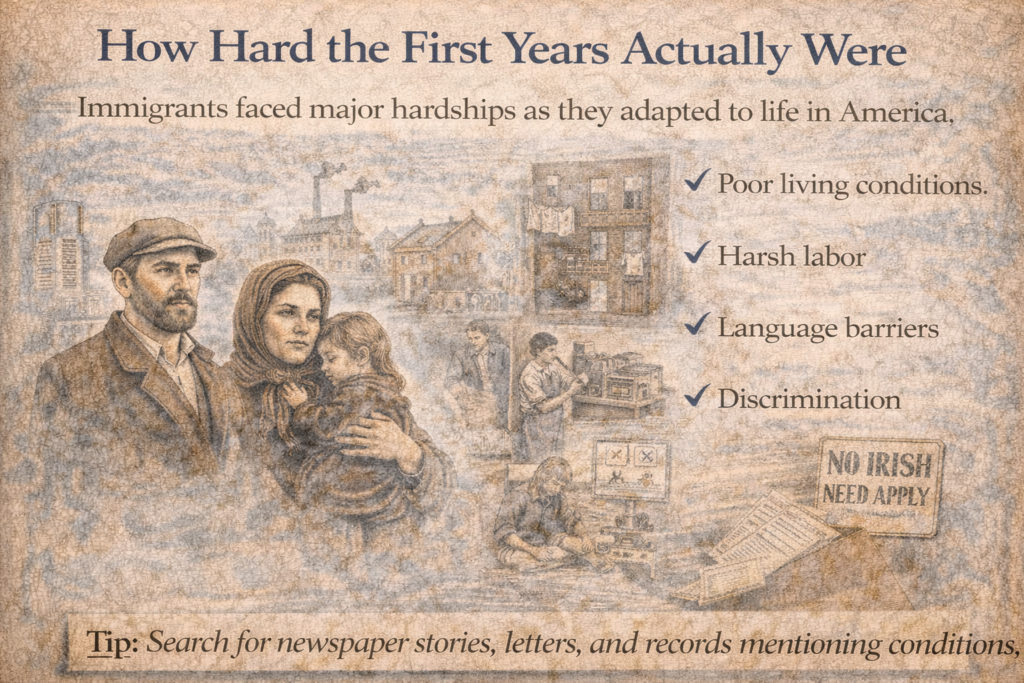
Every family has a version of the immigration story. It usually goes something like this: great-great-grandfather came over from the old country, worked hard, built a life. Maybe there’s a detail about the boat, or the name getting changed at Ellis Island, or the neighborhood where they first settled. The story is almost always a story of eventual success, because the people who told it lived long enough to tell it, and because human memory softens what was unbearable and keeps what can be made into a good story. What the family story almost never contains is an honest account of how brutal the first years actually were — and the records, if you know how to read them, tell a very different story than the one you grew up with.
They Arrived with Almost Nothing
The ship manifests from the peak immigration years record how much money each passenger had on arrival. The 1907 manifest form required this information specifically because federal officials wanted to exclude immigrants likely to become a public charge. The amounts recorded tell their own story. Many immigrants arrived with less than ten dollars. Some arrived with nothing at all and were carrying only what the manifest records as “clothing.”
Ten dollars in 1905 was roughly two to three weeks of wages for an unskilled laborer — if you found work immediately, which you often did not. It was enough to pay for a few nights in a boarding house and a few meals while you found your footing. It was not enough to absorb any delay, any illness, any piece of bad luck at all. Immigrants who arrived with ten dollars had almost no margin. Many of the people who appear in your family tree stepped off the boat one bad week away from genuine destitution.
The Boarding House Years
Most single male immigrants — and many married men who had come ahead of their families — lived in boarding houses run by people from their own ethnic community. These houses were often desperately overcrowded. Census records from immigrant neighborhoods in the early 1900s routinely show eight, ten, or twelve men listed as boarders in a single household, sharing beds in rotation with men who worked different shifts. The 1910 census in particular often captures this: a household headed by an immigrant family with a dozen boarders all working in the same mine or factory.
The boarding house provided more than a bed. It provided food, usually from a landlady who cooked in the old country’s style. It provided a community of people who spoke the same language and understood the same references. It provided information — which foreman was hiring, which neighborhood was safe, which labor contractor could be trusted and which ones could not. The boarding house was the immigrant’s entire social infrastructure in the first years, and it is worth finding in the census because the men listed alongside your ancestor were his community. They may be his relatives.
The Children Who Didn’t Survive
The death records from immigrant neighborhoods in the 1890s and 1900s are a corrective to any romanticized version of the immigrant story. Infant and child mortality rates in immigrant neighborhoods were significantly higher than the national average. Crowded housing, limited access to clean water, inadequate sanitation, the physical exhaustion of parents working twelve-hour shifts — these conditions killed children at rates that would be almost unimaginable today.
Family oral history often loses these children entirely. They died before they could be remembered by anyone still living. In census records they may appear as an infant in 1900 and be gone by 1910, with no explanation. Death records, where they survive, record the cause — and the causes recorded in immigrant neighborhood death records in this era read as a catalog of poverty’s consequences. Diphtheria. Typhoid. Enteritis. “Marasmus” — the clinical term for starvation in infants. These were not the deaths of people who had arrived and built a comfortable life. These were the deaths of people in the hardest years, before the life got built.
Why the Story Got Cleaned Up
The people who carried the immigration story forward were the people who survived it and succeeded. By the time they were old enough to tell it to grandchildren and great-grandchildren, the hardship had become history — something to be proud of having endured, not something to dwell on. The story became an origin myth: we came here with nothing, we worked hard, we made it. That’s the shape a hard story takes when it ends well.
What got edited out was the cost. The children who died. The years when the plan was to go back home and the money never accumulated enough to make that possible. The men who were injured in the mine or the factory and couldn’t work for months and fell into debt they spent years repaying. The loneliness that doesn’t make it into any record at all.
The records can restore some of what the oral history dropped. Not everything — the loneliness and the grief and the specific weight of a particular life don’t survive in census columns and ship manifest rows. But the bones of it are there. An ancestor who appears in five censuses in five different cities is a person who kept moving, kept starting over, never quite found the stable place. An ancestor whose household in 1900 includes four boarders and in 1910 includes none is a person whose circumstances changed. An ancestor who shows up in a city directory in 1905 and disappears entirely by 1908 is a story that got interrupted.
When you are building out an immigrant ancestor’s timeline, don’t just track where they were. Track what they had. Compare the 1900 and 1910 census records for household size, boarders, property ownership, and the ages and names of children present. The differences between those two snapshots — who was added, who was gone, whether they had moved from renting to owning — is the compressed story of ten years of a life. It will tell you more about who your ancestor was than any single document in the archive.
Read the records your ancestors left behind
Our free tools help you understand what census years, ship manifests, and naturalization papers were actually capturing — so you can read between the lines of your family’s history.