How Military Service Fast-Tracked Citizenship — And the Records It Created
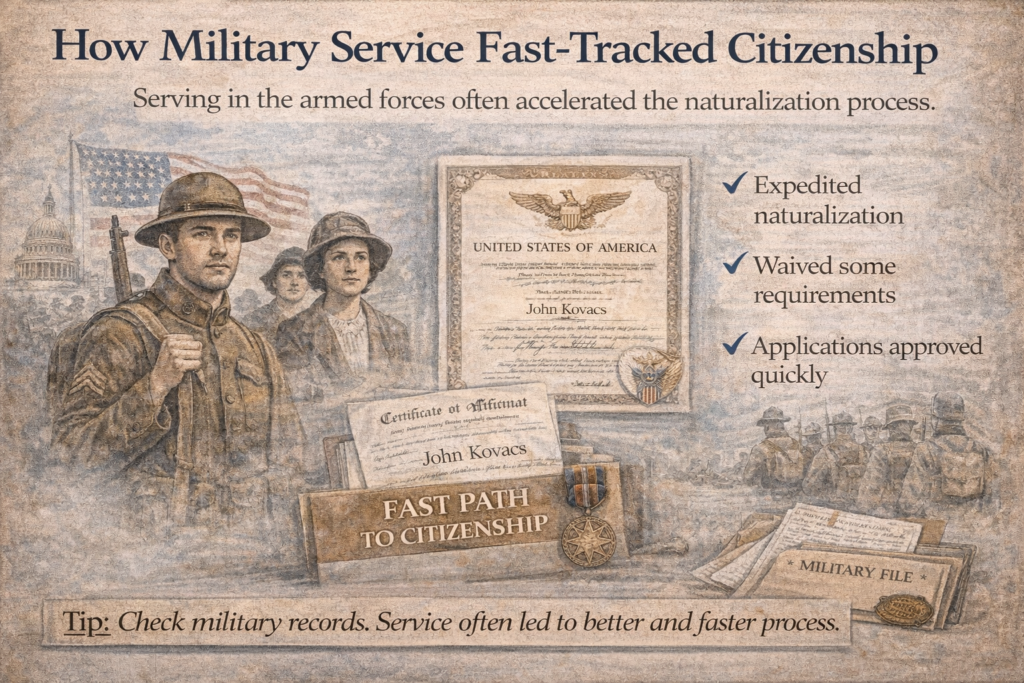
Across American history, the government made a consistent offer to immigrant men: serve in the military, and the path to citizenship gets shorter. Sometimes much shorter. Sometimes immediate. The men who took that offer left behind a distinct set of records — naturalization papers filed in unusual places, at unusual speeds, sometimes by men who had been in the country for only a few months. If your male immigrant ancestor served in any American war, his military service may have dramatically changed the citizenship records you should be looking for.
The Civil War: A Path for Anyone Who Served
During the Civil War, the federal government was desperate for soldiers. An Act of July 17, 1862 allowed any alien who had served at least one year in the Union Army to petition for naturalization with no prior Declaration of Intention required and with a reduced residency requirement. A separate provision allowed honorably discharged veterans to naturalize immediately after service, bypassing the waiting period entirely.
This produced naturalization records that look anomalous to researchers unfamiliar with the law. An immigrant who arrived in 1861, enlisted in 1862, served for two years, and naturalized in 1864 would have citizenship papers from only three years after arrival — far shorter than the standard five-year wait. The papers will typically note the military service as the basis for the expedited process.
Many Civil War naturalizations were handled by military courts rather than civilian courts, and some took place in the field — a regiment commander administering an oath to soldiers before a battle. These records are held in military archives and are not always linked to the civilian naturalization databases, which is why some Civil War veterans appear to have no civilian naturalization record: their citizenship was granted in a context that generated a different kind of paper trail.
World War I: Mass Naturalization Under Pressure
When the United States entered World War I in April 1917, there were hundreds of thousands of immigrant men in the country who were of military age, had been living in America for years, and were legally aliens. Some were from countries that were now enemies. The government faced an urgent need to clarify the citizenship status of men it was simultaneously drafting into military service.
The Act of May 9, 1918 — sometimes called the Soldier’s and Sailor’s Naturalization Act — allowed any alien who had served honorably in the US military during World War I to naturalize without the standard residency requirement and without first filing a Declaration of Intention. Men who had arrived in 1916 and enlisted in 1917 could naturalize in 1918 after less than two years in the country.
The 1918 act also allowed naturalization to be performed by any court or by military authorities, and many WWI naturalizations took place at military camps and training stations rather than in civilian courthouses. These records may be at NARA’s military records center in St. Louis rather than in the civilian naturalization databases where you might first think to look.
World War II: The Same Pattern, on a Larger Scale
World War II produced the largest single wave of military naturalizations in American history. The Nationality Act of 1940 and subsequent wartime legislation allowed aliens serving honorably in the US armed forces to petition for naturalization without the standard residency requirements, without filing First Papers, and with greatly reduced processing time. By the end of the war, approximately 144,000 men had naturalized through military service.
Like WWI, WWII military naturalizations often took place at military installations rather than civilian courts — sometimes on ships, sometimes at overseas bases, sometimes in field conditions. The records exist but they are not where researchers typically look for civilian naturalizations.
What Military Naturalization Records Contain
Military naturalization records typically contain the same biographical information as civilian records — name, age, birthplace, arrival date — plus the military-specific details: unit, rank, dates of service, and the specific legal authority under which the expedited naturalization was granted. The combination is often richer than a civilian record because two separate bureaucracies — military and immigration — both had an interest in accurately documenting the person.
If your male immigrant ancestor served in the Civil War, WWI, or WWII and you cannot find standard civilian naturalization records, search specifically for military naturalization records. For WWI and WWII, start with NARA’s military personnel records at archives.gov. For Civil War veterans, search the compiled military service records on Fold3, which sometimes note citizenship petitions. Also check pension records — a veteran’s pension file often contains more biographical detail than the naturalization record itself and may include the naturalization information you are looking for.
Calculate your ancestor’s citizenship path including military exemptions
The Naturalization Timeline Calculator accounts for Civil War, WWI, and WWII military service — showing you exactly what the expedited process looked like and what records it generated.