How Jewish Families Chose Their American Names — And What They Left Behind
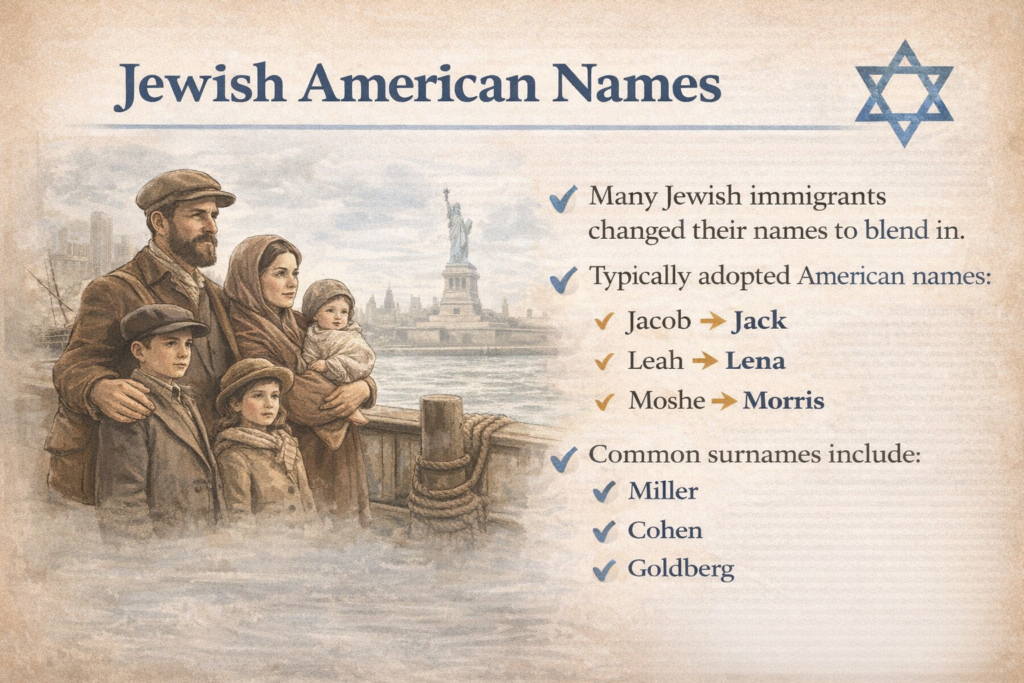
Moshe Goldschmidt stepped off a ship in 1903. Within six months he was Morris Goldman. His wife Rivka had become Rebecca. Their daughter Feige had become Fanny. The names they left behind in the shtetls of Eastern Europe were not just different names — they were a different world, a different language, a different identity. Understanding how and why Jewish immigrants renamed themselves is one of the most fascinating and emotionally complex stories in American genealogy.
A Community That Had Already Changed Its Names Once
To understand Jewish name changes in America, you need to understand that many Jewish families had already been through forced renaming once before they ever boarded a ship.
In the late eighteenth and early nineteenth centuries, the rulers of Prussia, Austria, and Russia — the empires that controlled most of Eastern Europe — required Jewish communities to adopt fixed, hereditary surnames for tax and conscription purposes. Before this, Jewish naming followed a similar patronymic tradition to other European communities, using the father’s name to identify the child.
In some regions, families were allowed to choose their own surnames. Wealthier, more educated families often chose beautiful names — Goldberg (gold mountain), Rosenberg (rose mountain), Blumenthal (flower valley). Poorer families sometimes had names assigned to them by officials who were not always sympathetic, which is one reason some Eastern European Jewish surnames carry meanings that are less than flattering.
So by the time the great wave of Jewish immigration began in the 1880s, many families already had surnames that were themselves relatively recent creations — names their grandparents had adopted or been given, not names that stretched back generations.
Yiddish Names and Their American Translations
The everyday language of most Eastern European Jewish immigrants was Yiddish — a language derived from medieval German with significant Hebrew, Aramaic, and Slavic influences. Yiddish names sounded nothing like English names, and many had no direct English equivalent at all.
The process of finding American equivalents was partly phonetic and partly by meaning. Moshe (Moses in Hebrew) became Morris because Morris sounded roughly similar and was a recognisable American name. Leib, the Yiddish word for lion, became Louis or Leon or Leo — names that shared the initial sound. Feige, meaning bird in Yiddish, became Fanny because the sounds were vaguely similar. Beile, meaning beautiful, became Bella or Belle.
✡️ Common Yiddish names and their American equivalents
The Speed of the Change
What is striking about Jewish name adoption in America is how quickly it happened. Unlike some immigrant communities where names shifted gradually over decades, many Jewish families made a deliberate break with their old names within weeks or months of arrival. This was not accidental — it was intentional and strategic.
Anti-Semitism was a real and present force in American life at the turn of the century. A conspicuously Jewish name was a barrier to employment, to housing, to advancement. Many employers openly refused to hire people with recognisably foreign or Jewish names. Changing your name was not an act of shame — it was an act of survival and pragmatism in a society that made its prejudices known very clearly.
Surnames: Gold, Silver, and the Meaning Behind Them
Jewish surnames in America often cluster around a recognisable set of elements. Gold, Silver, Rose, Green, Berg, Stein, Man, and their combinations appear across thousands of families. Understanding why helps you search more effectively.
Many of these surnames were chosen or assigned during the forced registration period in Europe precisely because they were pleasant, neutral, or aspirational. Gold and Silver suggested wealth. Rose and Blum suggested beauty. Berg and Stein were solid, respectable. These names were assigned to or chosen by families who wanted something they could live with, and they crossed the Atlantic intact because they were already Europeanised enough not to require translation.
Other surnames were translated by meaning rather than sound. A family named Goldschmidt — goldsmith in German — might become Goldman or Goldsmith in America. Schneider (tailor in German) sometimes became Taylor. Fleischer (butcher) sometimes became Fletcher. The occupation embedded in the surname was translated into its English equivalent and the family started fresh with a name that meant the same thing but sounded entirely different.
The Names That Stayed Hidden
Many Jewish families maintained two naming systems simultaneously — a Hebrew or Yiddish name used within the family and the Jewish community, and an English name used for official purposes and in the wider world. A man who was Moshe at synagogue was Morris at work. His gravestone might carry both names, one in Hebrew letters and one in English.
This dual naming is a gift to genealogists. Hebrew names on gravestones, in synagogue records, and in Jewish community newspapers often preserve the original name long after the official records have only the American version. If you can find your ancestor in a Jewish cemetery or a Yiddish-language newspaper, you may find the original name that has disappeared from every other record.
Jewish genealogy has some of the richest dedicated resources of any immigrant community. The JewishGen database holds millions of records from Eastern European communities. The YIVO Encyclopedia documents Yiddish culture and naming. Newspaper archives from the Yiddish press — the Forward, the Jewish Daily News — contain birth announcements, obituaries, and community notices that often preserve original names alongside American ones.
What This Means for Your Research
When tracing Jewish immigrant ancestors, treat the ship manifest name and the census name as two separate research problems that need to be connected rather than one continuous record. Find the American name first through census records, then work backwards to the arrival date, then search passenger records with every possible variant of the original Yiddish or Hebrew name.
The first name is often your most stable anchor across the name change, because even when the English equivalent sounds very different from the original, there is usually a phonetic or meaning-based logic to the translation that you can trace. The surname is more variable and more likely to have been changed completely.
Find the connection between the old name and the new
Our Ancestor Name Bridge includes Jewish and Yiddish name transformations in both directions — find likely ship log names from an American name, or find American equivalents from a Yiddish original.