
Birth Certificates: What They Tell You and What They Don’t
A birth certificate feels like the most basic, most reliable document in genealogy. A person was born, the event was recorded, and the facts are right there on the page. But birth certificates are not as straightforward as they appear — and the assumptions people make about them cause more research errors than almost any other record type.
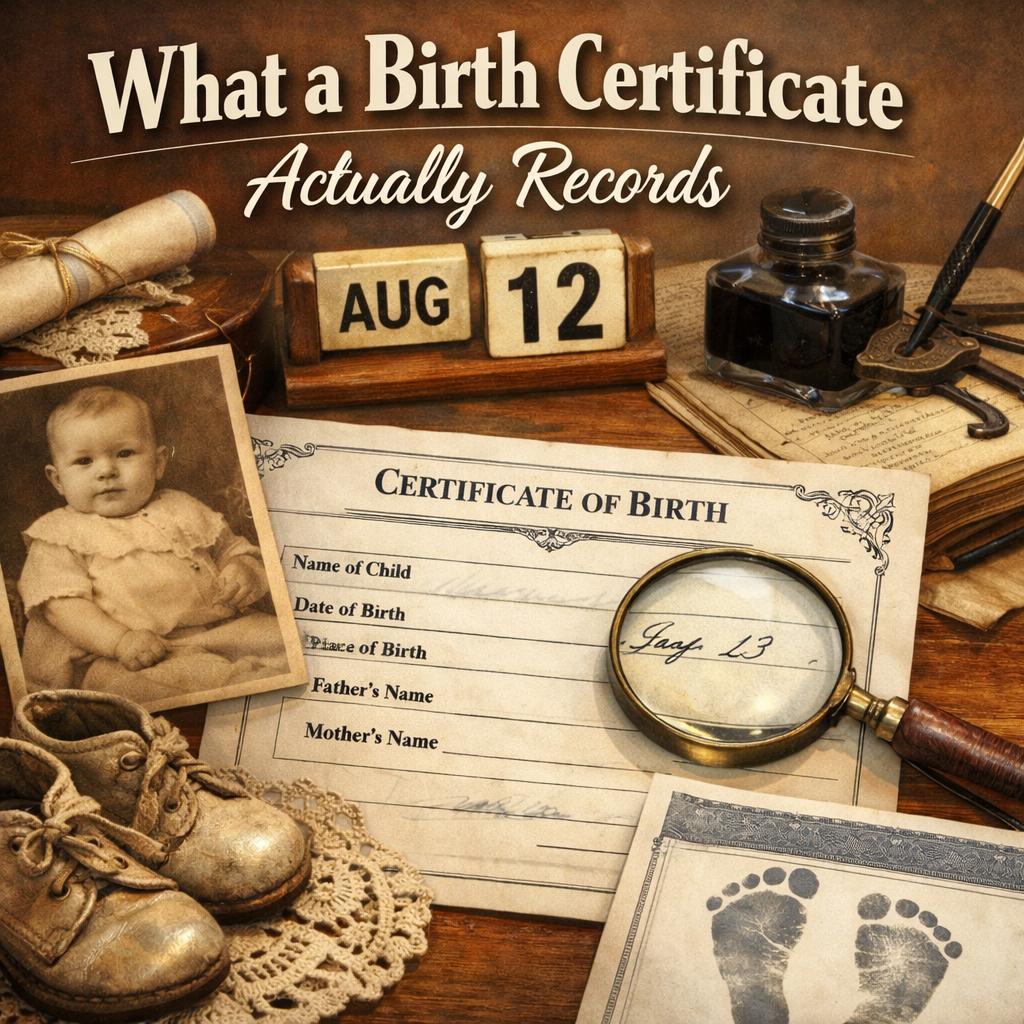
What a Birth Certificate Actually Records
A standard birth certificate records the child’s name, date of birth, place of birth, sex, and the parents’ names. Depending on the era and the state, it may also record the parents’ ages, birthplaces, occupations, residence, race, number of previous children, and the name of the attending physician or midwife.
That is a remarkable amount of genealogical information in one document. The parents’ birthplaces alone can push your research back a generation. The mother’s maiden name — recorded on almost every birth certificate — is one of the most valuable pieces of data in genealogy, because maiden names are the key to tracing the maternal line.
But here is the first thing most people do not realise: every piece of information on a birth certificate was provided by someone, and that someone was not always right.
Who Provided the Information — And Why It Matters
The informant on a birth certificate was usually the attending physician, the midwife, or one of the parents — most often the father. In theory, the father should know his own name, his wife’s name, and where they were both born. In practice, things were not always that simple.
Immigrant fathers sometimes gave Americanised versions of their names and their wife’s names. A man born Jozef Kowalski might tell the clerk his name was Joseph Kowalski — or Joseph Kowal, or even Joseph King. His wife Katarzyna might be recorded as Katherine or Catherine or Kate. These were not mistakes. They were deliberate choices made in the moment, and the birth certificate locked them in as the official version.
Birthplaces on birth certificates are particularly unreliable for immigrants. A father born in a village in Galicia might say he was born in Austria, or Poland, or Russia — all of which could be technically correct depending on the year and the political borders at the time. The clerk wrote down whatever the father said, and that single word on the birth certificate has sent researchers down the wrong path for decades.
When Birth Certificates Did Not Exist
Here is the second thing that catches people: birth certificates did not exist everywhere in America until surprisingly recently. There was no federal requirement for birth registration until well into the twentieth century, and individual states adopted vital registration at different times.
Massachusetts began requiring birth registration in 1841. New York City started in 1847, though compliance was poor for decades. Most northeastern and midwestern states followed between 1880 and 1910. But many southern and western states did not have reliable birth registration until the 1910s or even the 1920s. Mississippi did not require statewide birth registration until 1912, and Texas not until 1903 — with patchy compliance for years after.
If your ancestor was born before their state required registration, there is no birth certificate. The record simply does not exist. This is not because it was lost or destroyed — it was never created.
When no birth certificate exists, look for baptismal records (often recorded within days of birth), census records that give age and birthplace, family bibles, delayed birth certificates (filed later in life using supporting evidence), and school enrollment records that sometimes recorded a child’s date of birth.
Delayed Birth Certificates
In the 1930s through the 1960s, many Americans who were born before vital registration needed to prove their age — for Social Security, for passports, for military service. To do this, they filed delayed birth certificates. These are documents created decades after the birth, using whatever supporting evidence the applicant could provide.
A delayed birth certificate might cite a baptismal record, a family bible entry, a census record, a school record, or an affidavit from a relative who claimed to remember the birth. The quality of the evidence varies enormously. Some delayed certificates are supported by multiple independent records. Others rest on nothing more than the memory of an elderly sibling.
For genealogists, delayed birth certificates are valuable not just for the birth date they record, but for the supporting documents they cite. If the certificate mentions a baptismal record from a specific church, that tells you which church the family attended. If it cites a census record, that confirms where the family was living at a specific time. The supporting evidence is sometimes more useful than the certificate itself.
Amended and Corrected Birth Certificates
Birth certificates can be amended after the fact — for name changes, legitimation, adoption, or correction of errors. When this happens, the original certificate is usually sealed, and a new certificate is issued that looks like the original but contains the amended information.
For adoptees and their descendants, this means the birth certificate may show the adoptive parents’ names rather than the biological parents’ names. The original certificate, with the biological parents’ information, may be sealed by court order and inaccessible depending on the state’s laws.
Even outside of adoption, amendments can mislead researchers. A woman who married and took her husband’s surname might later have her birth certificate amended to reflect a different surname. A child whose parents married after the birth might have the father’s name added to a certificate that originally left it blank. These changes are not always noted on the certificate itself.
What the Birth Certificate Cannot Tell You
A birth certificate is a snapshot of one moment in time — the moment a child was born and someone filled out a form. It cannot tell you whether the parents stayed married, whether the family moved, whether the child survived infancy, or whether the names on the form were the names the family actually used.
It also cannot tell you with certainty that the information is accurate. Like every genealogical source, a birth certificate is a piece of evidence that needs to be evaluated in the context of everything else you know. The mother’s maiden name on the certificate should be corroborated by other records. The father’s birthplace should be checked against census records and naturalization papers. The date should be compared with baptismal records and family accounts.
A birth certificate is an essential record — one of the first you should look for. But it is not the final word on anything. It is the beginning of a conversation with the evidence, not the end of one.
Find out which records to look for
Our Document Checklist by Record Type generates a personalised research checklist based on your ancestor’s era, life events, and background — so you never miss a record that could break your brick wall.