What “First Papers” and “Second Papers” Actually Were — And Why Your Ancestor Might Have Only Filed One
In census records from 1900 to 1930, every immigrant has a citizenship status recorded next to their name. AL means alien — they hadn’t started the process. NA means naturalized — they were a full citizen. And PA means papers applied — they had done something, but not everything. Understanding what that something was, and why so many immigrants stopped at PA and never became NA, is one of the most useful things you can know for researching immigrant ancestors.
The Two-Step Process
From 1795 onward, becoming an American citizen was a deliberate two-step process designed to make people wait, reflect, and demonstrate genuine commitment before being admitted to full citizenship. The government wanted immigrants who were certain — not people who had naturalized impulsively and might change their minds.
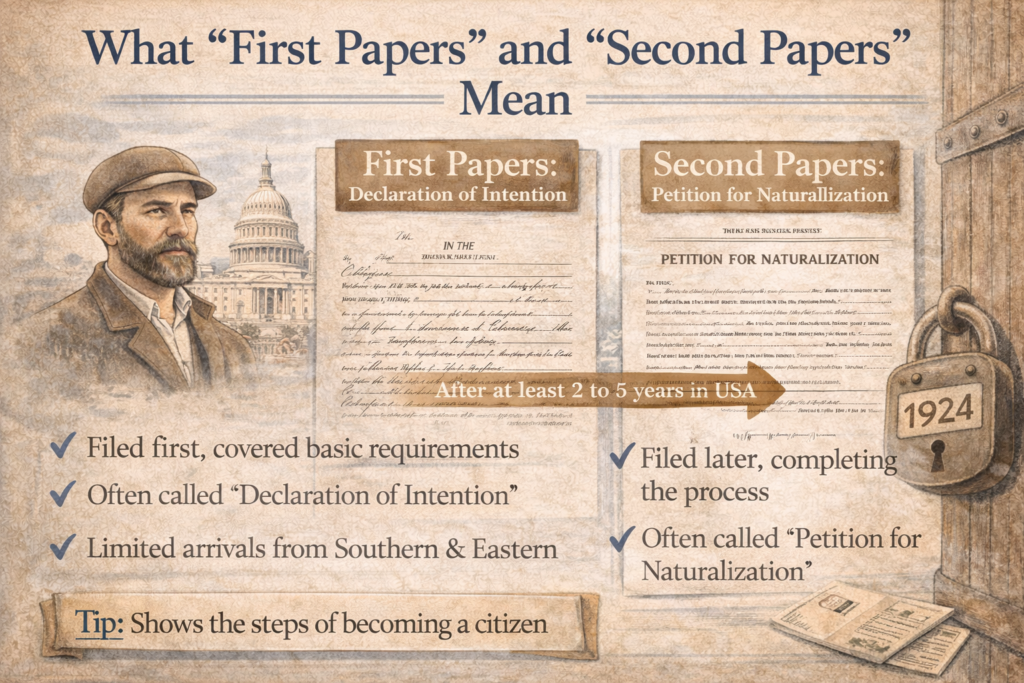
Step one was the Declaration of Intention — commonly called First Papers. The immigrant went to any court of record, raised their right hand, and swore that they intended to become an American citizen and renounce all allegiance to any foreign government. This was a declaration of intent, not a grant of citizenship. The immigrant was still an alien after filing First Papers — but they were an alien who had publicly committed to the path.
Step two was the Petition for Naturalization — Second Papers or Final Papers. After meeting the required years of residence, the immigrant returned to court, presented witnesses who vouched for their good character and residency, passed an examination, and was granted citizenship. At this point they received a Certificate of Citizenship and became a full American citizen.
How Long It Took
The minimum time between arrival and citizenship changed several times across American history. From 1795 onward the standard was five years of total residence — two years before First Papers could be filed, then three more years before Second Papers. In practice many immigrants waited much longer, filing First Papers years after arrival and Second Papers years after that.
The 1798 Naturalization Act — passed during a period of intense political anxiety about foreign influence — extended the residency requirement to fourteen years. An immigrant who arrived in 1799 under this law and wanted to naturalize had to wait until 1813 at the earliest. Many simply waited for the law to change, which it did in 1802 when the five-year requirement was restored. The 1798 law is worth knowing because it creates a gap in naturalization records for arrivals from that era that looks like the immigrant never naturalized — when in fact they may have naturalized much later than expected.
What First Papers Actually Said
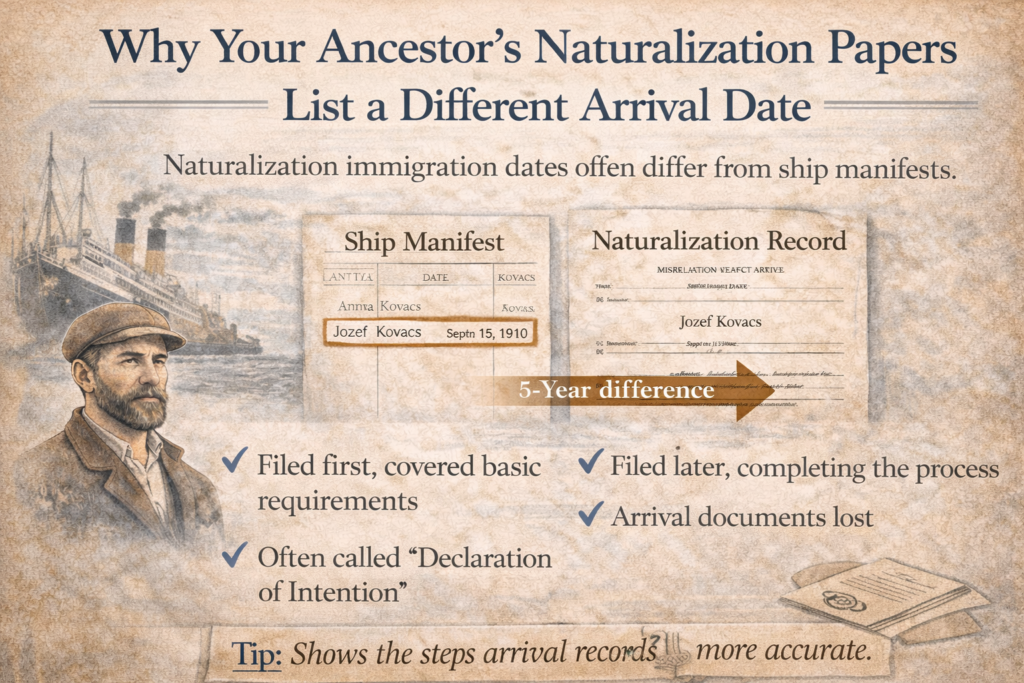
Before 1906, First Papers were filed in any convenient local court and the format was entirely up to that court. Some are rich — recording the immigrant’s name, age, birthplace, occupation, arrival date and port, and a physical description. Others are a single handwritten line recording nothing but a name and a date. The variation is enormous and you never know what you will find until you look.
After September 27, 1906, everything changed. The Basic Naturalization Act of 1906 standardized the entire process under federal oversight and introduced uniform forms. The post-1906 Declaration of Intention — Form 2202 — recorded the immigrant’s full name, age, physical description, birthplace, last foreign residence, port and date of arrival in the US, and occupation. For many immigrants, the post-1906 Declaration of Intention contains more biographical detail than any other document they ever generated in America.
What Second Papers Actually Said
The Petition for Naturalization — Second Papers — is typically the richer of the two documents. In addition to everything in the Declaration, it records the names and addresses of two witnesses who appeared in court to vouch for the applicant. These witnesses were almost always people who knew the immigrant personally — a neighbor, a coworker, a friend from the same community. They are worth researching in their own right, because they can lead you to other members of the immigrant community and sometimes to relatives who had arrived earlier.
Post-1906 petitions also ask whether the immigrant has ever been arrested, whether they are a polygamist or anarchist, and whether they have ever been to the United States before — the same screening questions used in the ship manifest, providing a second record of the answers. Discrepancies between what an immigrant told the ship inspector in 1905 and what they told the naturalization court in 1912 are themselves genealogically interesting.
Why So Many Immigrants Only Filed One
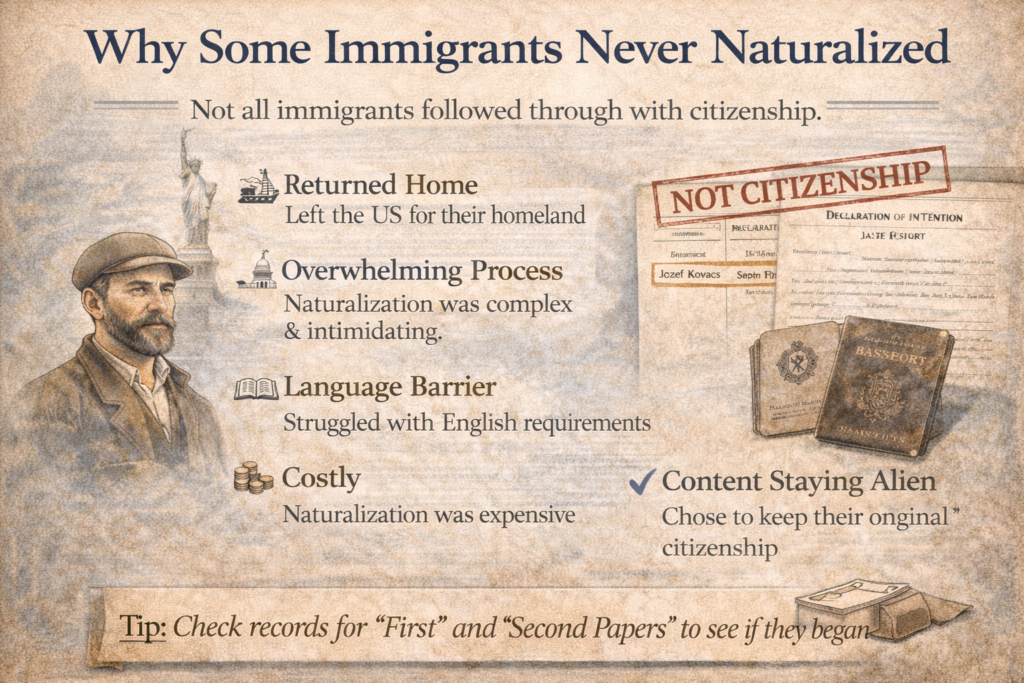
The PA status in census records — papers applied, meaning First Papers filed but Second Papers not yet completed — is extremely common. Many immigrants remained at PA for their entire lives, never completing the naturalization process. Understanding why helps you interpret the records correctly.
Some immigrants simply didn’t need to naturalize. Before 1906, many states allowed legal residents who had filed First Papers to vote in state elections without completing naturalization. An immigrant who could vote, own property, and live comfortably without the final step had less practical incentive to complete it.
Some immigrants always intended to return home. Men who came to America to earn money and send it back to a family in Europe, planning eventually to go back themselves, had no reason to become citizens. Many of them are recorded as PA in census after census — the First Papers filed to establish legal status, the Second Papers never filed because the plan was always to go home eventually.
And some immigrants simply ran out of time. The 1906 law introduced a seven-year expiration on First Papers — if Second Papers were not filed within seven years of the Declaration, the Declaration expired and the whole process had to start again. An immigrant who filed First Papers in 1907 and then moved, changed jobs, had a family crisis, or simply got busy might find their Declaration had expired before they got back to the courthouse.
If your ancestor is listed as PA in the 1900, 1910, or 1920 census but you cannot find a completed naturalization, search specifically for the Declaration of Intention — First Papers — rather than the Petition. First Papers survive separately from Second Papers and are held in different court records. Finding the Declaration even without a completed naturalization gives you a document that may contain birthplace, arrival date, and physical description that appear nowhere else in American records.
Calculate your ancestor’s full naturalization timeline
Our Naturalization Timeline Calculator shows you exactly what the process looked like in your ancestor’s era — what documents it generated, where to find them, and what each one typically contains.