What “Race or People” Means on a Ship Manifest — and Why It’s More Useful Than Country of Origin
Your ancestor’s ship manifest says they came from Russia. But the column next to country of origin says something different — Lithuanian. Or Ruthenian. Or Hebrew. Or Magyar. That second column, added to ship manifests in 1903, is one of the most misunderstood and most valuable fields in the entire record. It cuts through the political geography of empires to tell you something much more specific about who your ancestor actually was.
Why Country of Origin Is Often Misleading
In the decades of peak immigration — roughly 1880 to 1924 — much of Eastern Europe was divided among three empires: Russia, Austria-Hungary, and Germany. The countries we recognize today — Poland, Lithuania, Latvia, Ukraine, Hungary, Czech Republic, Slovakia — did not exist as independent nations. Their inhabitants were subjects of whichever empire controlled their territory, and that empire’s name was what appeared on their travel documents and in their immigration records.
A Lithuanian farmer, a Ukrainian schoolteacher, a Polish factory worker, and a Jewish merchant might all be recorded as Russian in American documents — because they all lived in territory controlled by the Russian Empire. They shared a political status and nothing else. Their languages were different, their cultures were different, their religious communities were different, and the European records that document their families are organized by these ethnic and regional identities rather than by imperial citizenship.
Searching for European records using country of origin alone is like searching a library by the building it’s in rather than the subject it covers. The empire tells you which shelf the records are on. The ethnic identity tells you which book to pull.
What the “Race or People” Column Actually Records
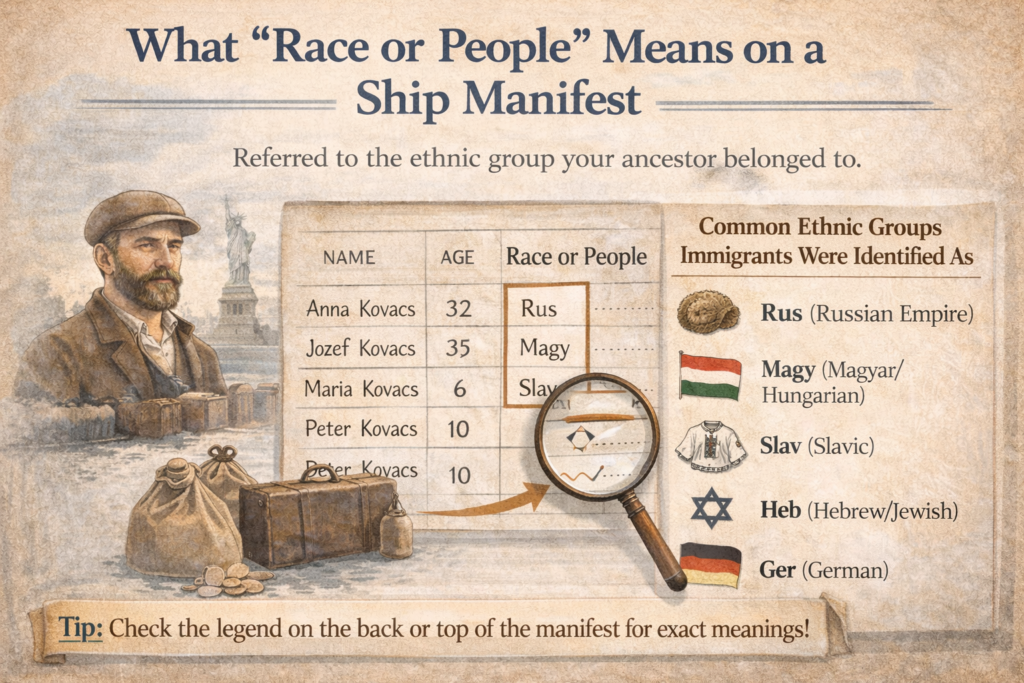
The “race or people” column — added to US ship manifests in 1903 — was an attempt to capture ethnic identity rather than political nationality. The terminology is jarring to modern readers, because “race” in 1903 was used to describe what we would now call ethnic groups, nationalities, and cultural communities. The column was not recording skin color — it was recording a person’s linguistic and cultural origin.
Immigration officials used a standardized list of categories. These categories were imperfect and sometimes inconsistently applied, but they are enormously useful for genealogical research because they point you toward the right set of European records.
📋 Race or people terms and what they mean for your research
How to Use This for Your Research
Once you know the “race or people” entry, you know which community’s records to search in Europe. A Hebrew ancestor’s family records are in Jewish community registers — birth and death books kept by the Jewish community, not the general civil registration system. A Ruthenian ancestor’s records may be in Greek Catholic church registers rather than Roman Catholic or Orthodox ones. A Magyar ancestor’s records are in Hungarian archives even if the manifest says Austria.
When the Column Creates New Confusion
The race or people column was filled in by immigration inspectors, not by the immigrants themselves. The inspector made a judgment based on what they were told and what they observed. An inspector who misunderstood an answer, who had limited knowledge of Eastern European ethnic distinctions, or who was working through a rushed interpretation process might record the wrong category.
A Belarusian might be recorded as Russian. A Sorb might be recorded as German. A Sephardic Jewish immigrant from Greece might be recorded as Greek or as Hebrew depending on the inspector’s assumptions. Cross-reference the race column with the last residence column — the specific village or city of last residence is often more reliable as an indicator of true origin than the race category, because it came directly from the immigrant’s own statement about where they lived.
If your ancestor’s race or people column shows a term you don’t recognize, search it specifically — many terms used in 1903–1924 manifests are historical ethnic designations that no longer appear in everyday use. Ruthenian, Wendish, Galician, Bucovinian, and Macedonian are all examples of terms that point to specific geographic and cultural communities with their own archival records and research strategies.
Find out what your ancestor’s manifest era recorded
The race or people column appears in manifests from 1903 onward. Our Ship Manifest Column Decoder shows you exactly which fields each era recorded and what each one means for your research.