What the Two Witnesses on a Naturalization Petition Can Tell You — And Why They’re Worth Researching Too
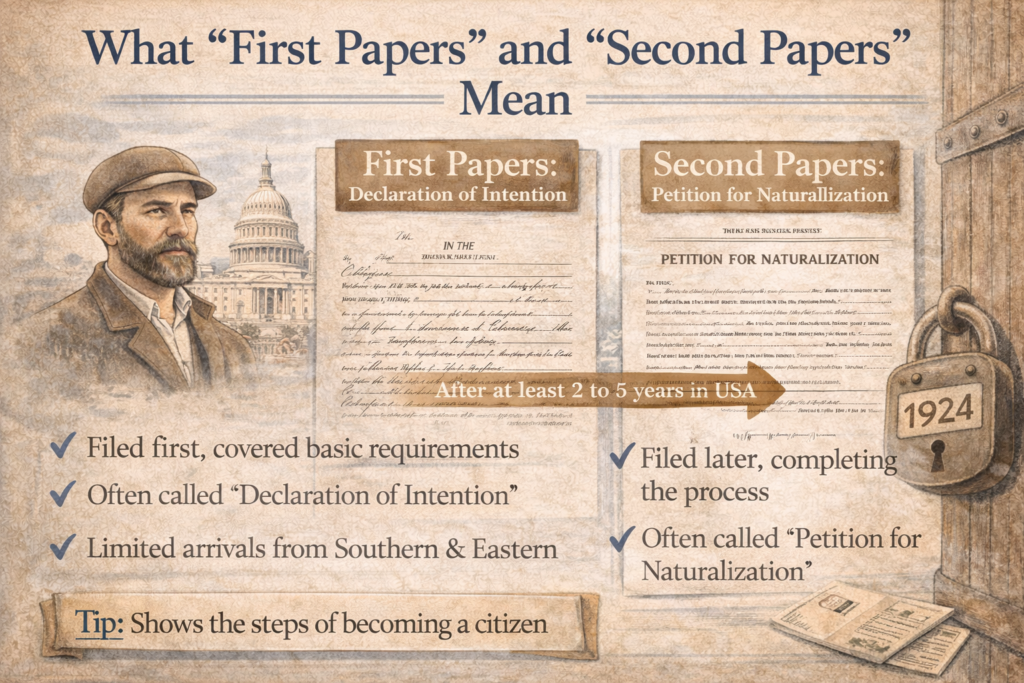
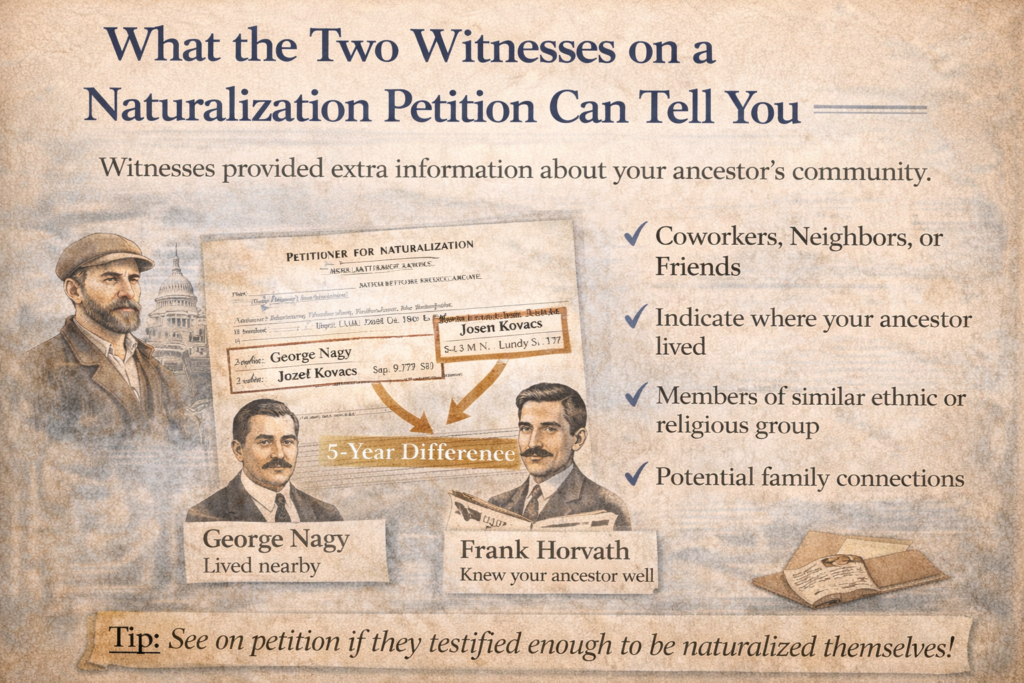
When your ancestor filed their Petition for Naturalization — Second Papers — they were required to bring two witnesses to court. These witnesses swore under oath that they personally knew the applicant, had known them for at least five years, and could vouch for their continuous residence in the United States and their good moral character. Their names are recorded on the petition. Most researchers copy down the ancestor’s name and move on. The witnesses deserve a closer look.
Who Actually Showed Up as a Witness
The law required two witnesses. It did not specify who those witnesses had to be, beyond requiring that they were American citizens who had known the applicant personally for the required period. In practice, immigrants drew from a small pool of people they genuinely trusted — people who knew them well enough to answer questions in court and who were willing to take an afternoon away from work to appear before a judge.
These were not strangers pulled off the street. They were people embedded in the immigrant’s actual life. Most commonly they were neighbors, particularly neighbors from the same ethnic community or the same street. They were coworkers from the same factory or mine. They were members of the same fraternal organization, the same church, the same mutual aid society. Very frequently they were relatives — a cousin who had arrived earlier, a brother-in-law, an uncle who had already naturalized and could now vouch for the family member who came later.
The two names on the witness line of a naturalization petition are, in almost every case, a direct window into the immigrant’s personal community.
What the Witnesses’ Records Can Tell You About Your Ancestor
Once you have the witnesses’ names, look them up. Find them in the census. Find their own naturalization records. Find their ship manifests.
A witness who shares a surname with your ancestor is almost certainly a relative. A witness who arrived on the same ship, or in the same year, or from the same village, confirms a connection that might otherwise be impossible to establish. A witness whose naturalization papers list the same address as your ancestor puts both people at the same location at the same time.
Witnesses also appear in reverse. If you are researching someone and you cannot find their naturalization record, search the naturalization records of people from the same ethnic community in the same county and time period. Your ancestor’s name may appear as a witness on someone else’s petition — which gives you a document containing their name, address, and sworn statement of continuous residence, even if their own naturalization papers have not survived or have not been indexed.
Finding the Witnesses in Later Records
After you identify the witnesses, track them through the same records you use for your direct ancestor. Find them in the 1910, 1920, and 1930 censuses. If they appear in the same household as your ancestor in any census year, or in the same street, or in the same building, that proximity tells you something about how tightly knit the community was. If their children married your ancestor’s children, the witness relationship was likely a family relationship that the records didn’t explicitly label.
Death records and obituaries for witnesses are particularly useful. An immigrant community obituary in an ethnic-language newspaper often names every member of the extended family network — and a witness to your ancestor’s naturalization may have an obituary that names his own relatives in the same breath as yours.
When the Same Witnesses Appear Multiple Times
In immigrant communities, the same two or three people often appear as witnesses across dozens of naturalization petitions over a period of years. These serial witnesses were community figures — men who were known, trusted, and available, who understood the process and were willing to repeat it. Sometimes they were leaders of the local ethnic fraternal organization. Sometimes they were saloonkeepers or boarding-house operators who knew virtually everyone in the community. Sometimes they were the local ward politician who made it his business to help new citizens through the process.
Finding one of these serial witnesses in your ancestor’s records places your ancestor within a specific community network, and the other people that same witness vouched for are almost certainly people your ancestor knew personally.
When you find the witnesses on your ancestor’s naturalization petition, search for their naturalization records too. The post-1906 Petition for Naturalization (Form 2204) recorded each witness’s name, address, and occupation. These details let you locate the witness in census records and map the geographic footprint of your ancestor’s community. Ancestry and FamilySearch both index naturalization petitions — search by witness name as well as by applicant name.
Understand the full naturalization process in your ancestor’s era
The Naturalization Timeline Calculator shows you exactly what documents the process generated, what each one recorded, and where those records are held today.