Why Naturalization Records Before 1906 Are So Hard to Find — And Where to Look
If your ancestor arrived before 1906 and you’re searching for their naturalization records, you may have already discovered the problem: there is no single place to look. The records are scattered across hundreds of courthouses in dozens of states, many of them never digitized, some of them lost entirely. Understanding why they’re so fragmented is the first step to finding them anyway.
Any Court Could Naturalize Anyone
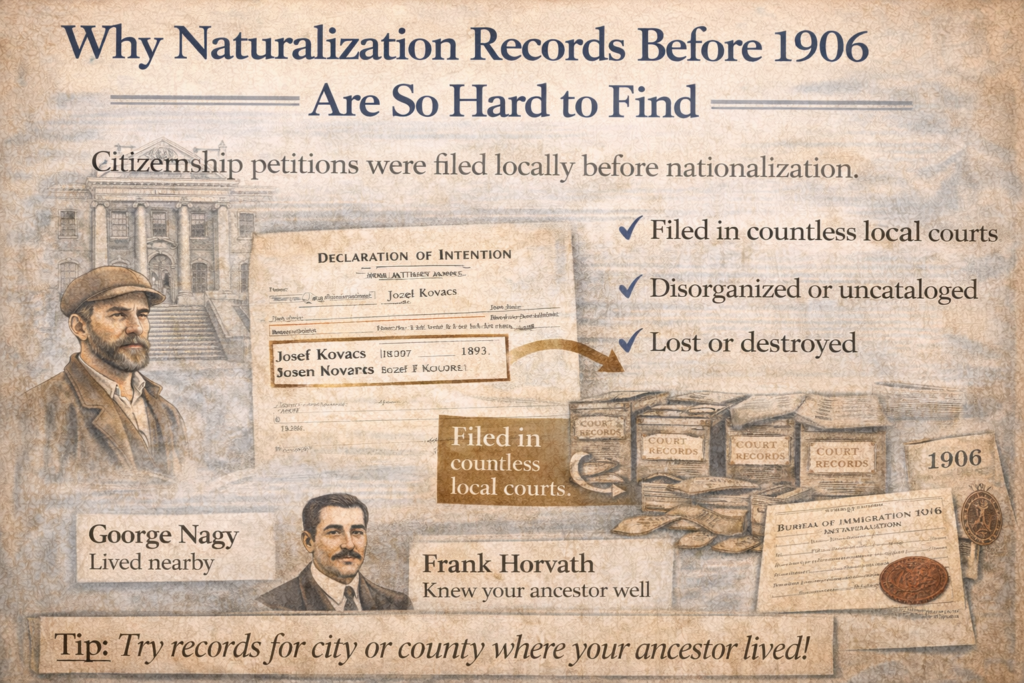
From the earliest naturalization laws through September 26, 1906, any court of record in the United States had the authority to naturalize immigrants. Federal courts, state courts, county courts, city courts, circuit courts, district courts, probate courts — if a court had a seal and kept records, it could grant citizenship. There was no requirement to use a federal court or even a court in the county where the immigrant lived.
This meant that an immigrant in rural Pennsylvania might naturalize in the nearest county court, or they might travel to the nearest city with a federal court that processed naturalizations quickly. They might naturalize in one state and move to another the following year. They might naturalize in a court that has since been dissolved, whose records were transferred to a county archive that has never been fully inventoried.
There was also no central registry. Courts did not report naturalizations to any federal agency. No one was keeping a national list. Each court maintained its own records in its own format, and those records stayed where they were created.
The Format Varied Enormously
Before 1906, there were no standard federal forms for naturalization. Courts recorded what they chose to record, in whatever format made sense to the clerk handling the paperwork. Some courts produced rich, detailed records containing the immigrant’s name, age, birthplace, occupation, physical description, arrival date and port, and the names of witnesses. Others recorded nothing but a name and a date in the margin of a docket book.
This means that two ancestors who both naturalized in 1895 might have completely different quality records — not because one court was more diligent than the other, but because the courts were operating entirely independently with no shared standards. You cannot know what a pre-1906 naturalization record contains until you actually find it.
Where Pre-1906 Records Are Now
Pre-1906 naturalization records are held in several different places depending on which court created them and what happened to that court’s records over time.
Federal court records from before 1906 are held by the National Archives regional facilities. The NARA online catalog (catalog.archives.gov) lists what has been digitized or microfilmed, but significant portions of the pre-1906 federal court naturalization records have not been digitized and must be requested in person or by mail from the appropriate regional facility.
State and county court records are typically held by the court itself, by the state archives, or by the county historical society. The location depends entirely on what happened to that particular court’s records over the past century. Some have been microfilmed by the LDS Church and are available through FamilySearch. Some have been digitized by Ancestry or Fold3. Many have not been digitized at all.
The best first step is to identify which county your ancestor lived in during the most likely naturalization years, then contact the county clerk, county historical society, and state archives to ask what pre-1906 naturalization records survive and where they are held.
The WPA Project Records
During the 1930s and 1940s, the Works Progress Administration conducted a systematic survey of naturalization records held by courts across the country. WPA workers created indexes — not the records themselves, but indexes pointing to where records could be found. These WPA indexes survive for many counties and have been microfilmed and digitized. They are searchable on Ancestry and through NARA.
A WPA index entry for your ancestor will typically give you a name, a volume and page number, and the name of the court. It will not give you the full document. But it tells you exactly where the full document is, which is the information you need to order it.
If you cannot find your pre-1906 ancestor in any online naturalization database, try two additional approaches before concluding the records don’t exist. First, search the FamilySearch catalog for the specific county and state, filtered to naturalization records — FamilySearch has microfilmed many county court records that are not on Ancestry. Second, contact the county clerk’s office directly. Many clerks can confirm whether pre-1906 naturalization dockets survive, even if no one has ever digitized them, and some will make copies for a small fee. The records may be sitting in a basement cabinet, perfectly intact, simply waiting for someone to ask.
Find out what naturalization records exist for your ancestor’s arrival year
The Naturalization Timeline Calculator tells you exactly what the process generated in your ancestor’s era, where those records are held, and what each document typically contains.