Why Some Immigrants Never Naturalized at All — And What That Means for Your Research
You’ve searched every naturalization database. You’ve checked the county courthouse records and the federal archives. You’ve looked at the census and your ancestor is listed as AL — alien — in 1900, 1910, 1920, and 1930. They lived in America for forty years and never became a citizen. You want to know why. The answer, when you find it, often tells you something important about who your ancestor actually was.
They Always Planned to Go Home
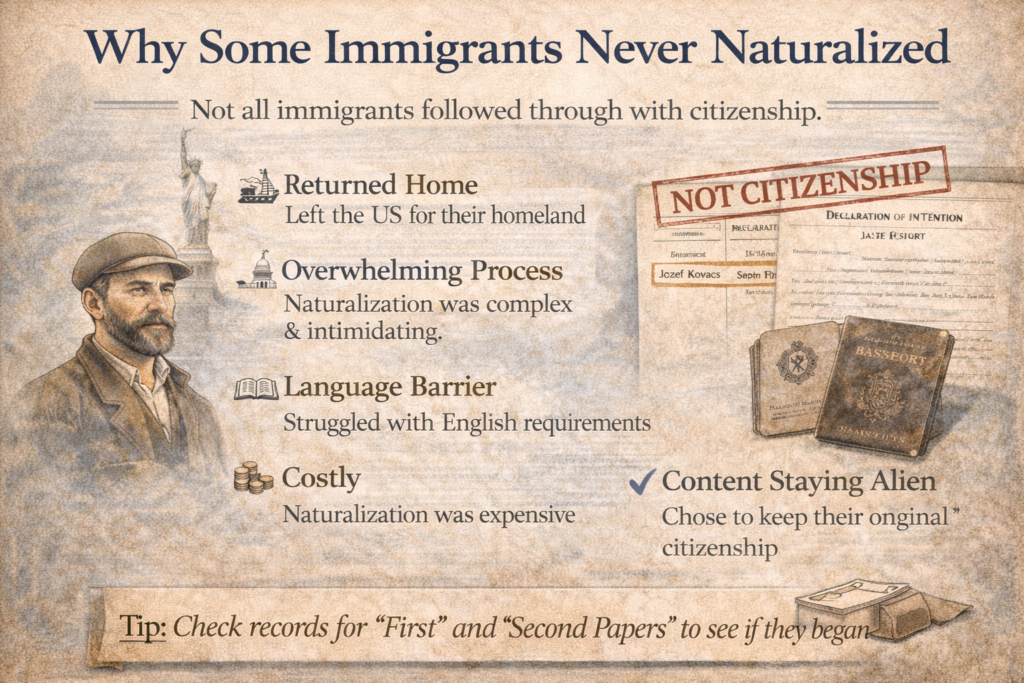
The largest single reason immigrants never naturalized is one that American-born descendants rarely consider: many immigrants never intended to stay. They came to earn, save, and return. The industrial towns of Pennsylvania and Ohio were full of men who had left wives and children in Poland, Italy, Hungary, or Greece, who were sending a substantial portion of every paycheck across the ocean, and who measured their American stay in years, not decades.
These men are sometimes called “birds of passage” in contemporary accounts. They moved between America and Europe repeatedly, following the work. They had no interest in American citizenship — it would have complicated their return home and in some countries meant losing their original citizenship. For them, remaining an alien was a practical choice that reflected their actual life plan. That the plan often changed — that they eventually stayed, or that a wife and children eventually joined them, or that a war back home made return impossible — does not change the original intention.
When you find an ancestor who lived in America for decades without naturalizing, the first question worth asking is not “why didn’t they become a citizen?” but “did they always mean to come back?”
They Didn’t Need To
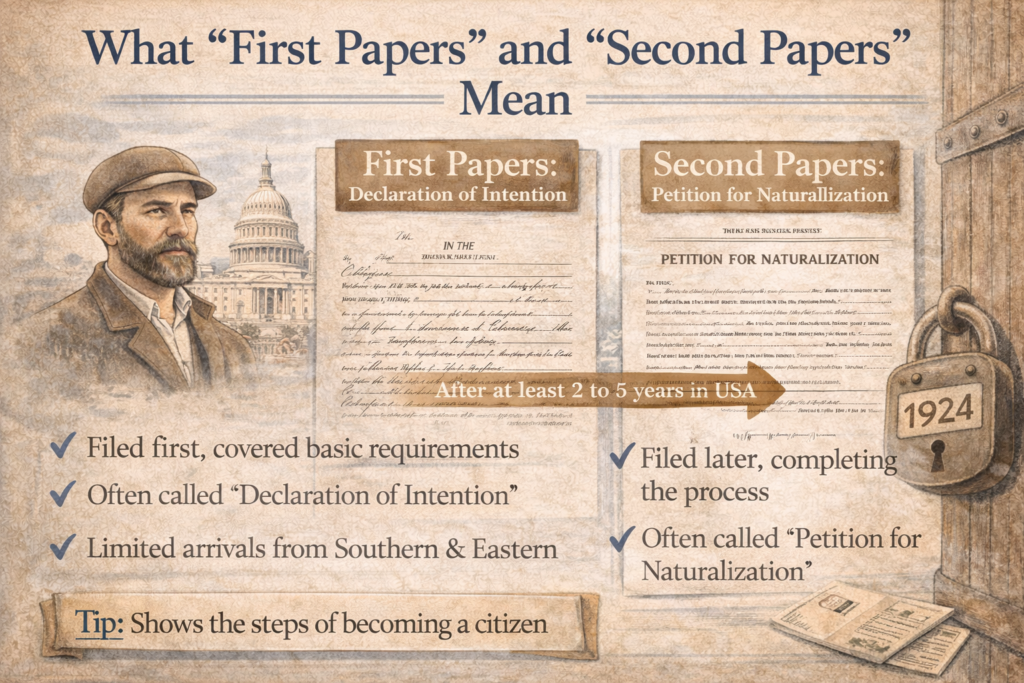
For much of the nineteenth century, American citizenship carried fewer exclusive benefits than most people assume. Many states allowed immigrants who had filed First Papers — a Declaration of Intention — to vote in state elections without completing naturalization. Property could be owned. Businesses could be operated. Children born in America were automatically citizens regardless of the parents’ status. The practical difference between an alien with First Papers and a naturalized citizen was, in many states, smaller than you might expect.
Some immigrants made a rational calculation that the time and effort of completing the naturalization process — the court appearances, the witnesses, the examination — was not worth the additional benefits it conferred. They were already living a full American life. Citizenship was a formality they could always do later. And then they didn’t.
The Language Barrier Was Real
Naturalization required appearing in court and demonstrating some ability to communicate in English. Before 1906 the requirements were informal and courts varied enormously in how strictly they applied them. After 1906 the process became more standardized and more demanding. For an immigrant who had spent twenty years in an ethnic enclave — working with people from the same village, shopping at stores run by people who spoke the same language, attending a church that conducted services in the old language — English might remain genuinely limited even after decades in America.
This was especially true for immigrant women, who were often more confined to domestic and community spaces and had fewer opportunities to learn English than men who worked in mixed-language environments. After 1922, when the Cable Act gave women independent citizenship rights, women had to naturalize on their own — but the language requirement created a real barrier for women who had never had cause to learn English.
The Law Excluded Some People Entirely
Not everyone was allowed to naturalize, regardless of how long they had lived in America or how much they wanted to become citizens. The Chinese Exclusion Act of 1882 barred Chinese immigrants from naturalizing. The 1790 Naturalization Act had limited naturalization to “free white persons,” and while the definition of “white” was contested and expanded over time, it was used to bar naturalization for Japanese, Korean, Filipino, South Asian, and other immigrants well into the twentieth century.
The 1924 Immigration Act introduced the category of “aliens ineligible for citizenship” — a legal term that tracked the racial exclusions and had consequences beyond naturalization, including land ownership restrictions in many western states. An ancestor listed as AL in census records who arrived from Asia or the Pacific may not have been disinterested in citizenship — they may have been legally prohibited from obtaining it.
Something Interrupted the Process
Many immigrants began the naturalization process and never finished it — not because they gave up, but because life intervened. The most common interruption was moving. Before 1906 there was no central registry, and naturalization records stayed in the court where they were filed. An immigrant who filed First Papers in Illinois in 1895 and moved to Montana in 1898 would need to start over — or might not realize they needed to, or might intend to find a court in Montana and simply never get around to it.
After 1906, First Papers expired after seven years if Second Papers were not filed. An immigrant dealing with illness, family crisis, financial hardship, or the disruptions of WWI might simply run out the clock on their Declaration without meaning to.
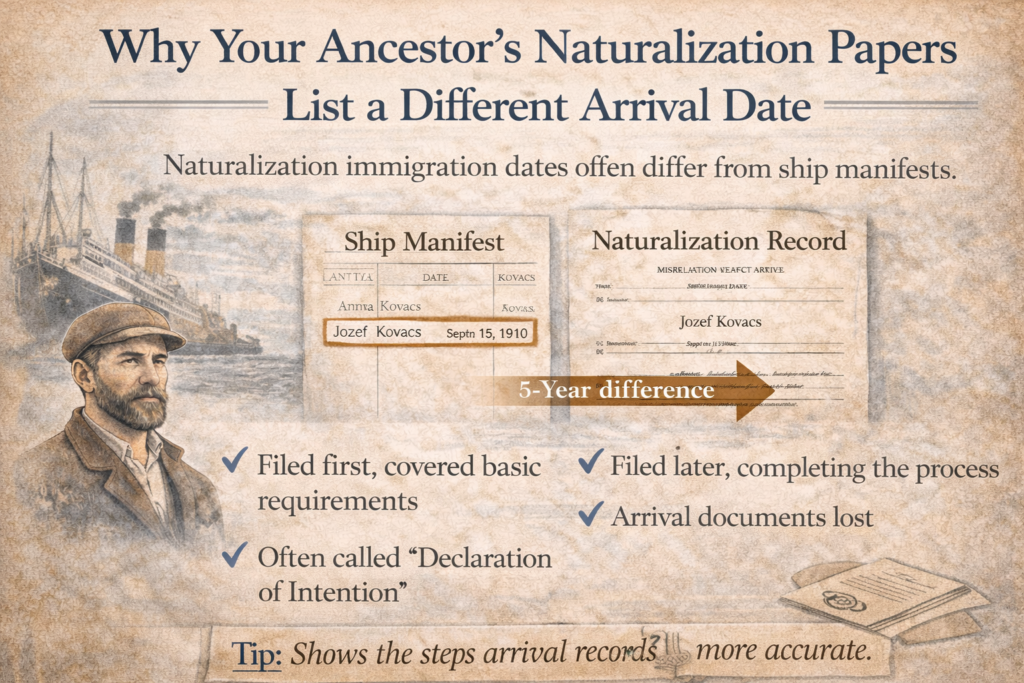
An ancestor who never naturalized may still have filed First Papers — a Declaration of Intention — which is its own valuable genealogical document. Declarations filed after 1906 are especially rich, recording physical description, birthplace, last foreign residence, and arrival date. Search the NARA online catalog, Ancestry’s naturalization indexes, and Fold3 specifically for Declaration of Intention records even if you know your ancestor never completed the process. The Declaration may be the most detailed record of their origins that exists.
See what the naturalization process looked like in your ancestor’s era
The Naturalization Timeline Calculator walks you through the exact process, documents, and requirements for any arrival year from 1790 to 1940.