Why the 1798 Law Made Immigrants Wait 14 Years for Citizenship
If your ancestor arrived in America in the late 1790s and you’re trying to find their naturalization papers, you may run into something puzzling: the timeline doesn’t add up. They arrived in 1798, but they didn’t naturalize until 1815. You might assume the records are incomplete, or that they simply delayed. But there’s a more specific explanation — and it’s one of the stranger episodes in American naturalization history, driven entirely by political fear at a moment when the young republic thought it might not survive.
The Crisis of 1798
In the spring of 1798, the United States was in the grip of what historians call the Quasi-War — an undeclared naval conflict with France that threatened to become a full-scale war. The political atmosphere was toxic. The Federalist Party, which controlled Congress and the presidency under John Adams, was convinced that French agents were operating inside the United States, that Irish and French immigrants were especially sympathetic to France, and that the recent wave of immigration was flooding the country with people who were loyal to foreign powers rather than to the American republic.
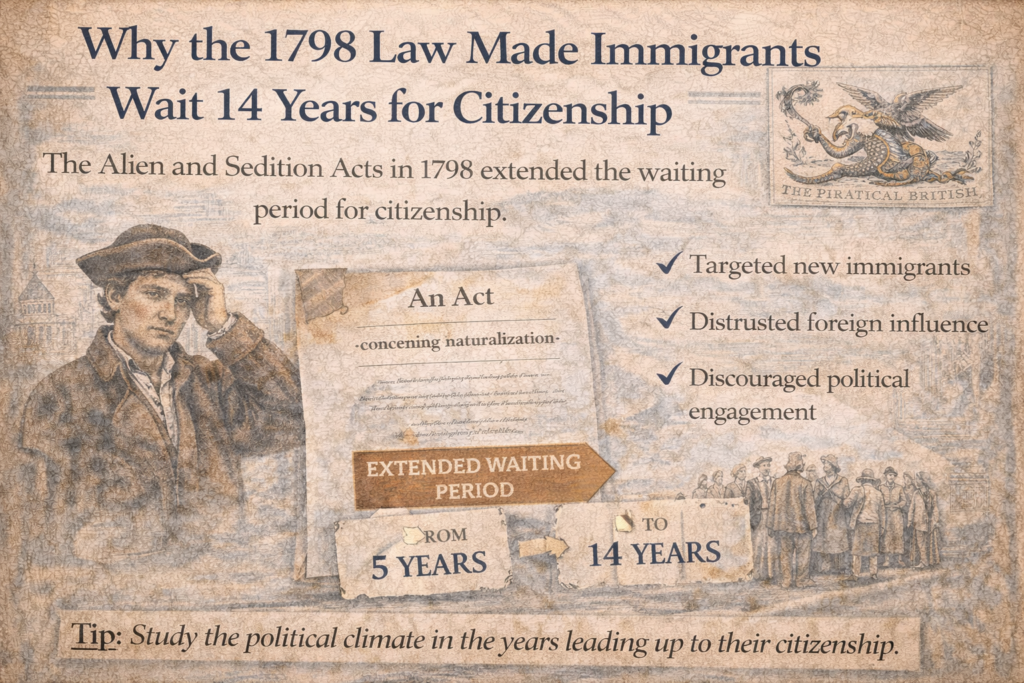
The response was a set of laws passed in the summer of 1798 — the Alien and Sedition Acts — that are among the most controversial legislation in early American history. The Naturalization Act of 1798 was part of this package. Its centerpiece was a dramatic extension of the residency requirement for citizenship: from five years to fourteen years.
What Fourteen Years Meant in Practice
An immigrant who arrived in 1799 and wanted to become an American citizen under the 1798 law would have to wait until 1813 at the earliest — and even then, only if they had filed a Declaration of Intention at the correct point in the process. The five-year requirement that had been in place since 1795 had already seemed long to some immigrants. Fourteen years was effectively a generation.
The law also introduced new requirements for Declaration of Intention filings, requiring them to be made no fewer than five years before the petition for citizenship — meaning that even an immigrant who arrived on the first day the law took effect could not begin the clock on their five-year declaration period until they had already been in the country for five years, waited another five, and then petitioned after a total of ten years of residence. The full fourteen-year requirement applied to the complete process.
For immigrants who had arrived under the previous 1795 law with a five-year expectation, the 1798 change was particularly disorienting. Men who had planned to naturalize in a few years suddenly found the goal posts had moved dramatically. Some filed their declarations and waited. Others simply stopped counting and got on with their lives.
The Law Was Repealed in 1802
The Federalist Party lost the election of 1800. Thomas Jefferson and the Democratic-Republicans swept Congress and the presidency, and one of their first priorities was unwinding the Alien and Sedition Acts, which they had opposed vigorously. The Naturalization Act of 1802 repealed the 1798 law and restored the five-year residency requirement that remains the standard to this day.
But what happened to the immigrants who had arrived between 1798 and 1802 and were counting on the fourteen-year requirement being reduced? The 1802 law was not retroactive in a simple sense. Immigrants who had already filed Declarations of Intention under the 1798 law were generally able to proceed under the more favorable 1802 terms, but the legal situation was genuinely complicated, and different courts handled it differently. Some immigrants who arrived in 1799 and had been waiting out the fourteen-year clock found themselves able to naturalize much sooner after 1802. Others continued waiting because the legal situation in their jurisdiction remained unclear.
The Pre-1820 Problem Generally
The 1798 law is one reason early naturalization records are difficult. But it sits within a broader challenge: before 1820, immigration records generally are sparse. There was no systematic recording of arrivals at American ports before the Steerage Act of 1819 required passenger lists to be filed with customs collectors. Ship manifests before 1820 are incomplete and often don’t survive. Naturalization records before 1906 were held by local courts with no central registry. The combination makes the pre-1820 period the hardest in American genealogy.
An ancestor who arrived in the 1790s or early 1800s may have left almost no immigration paper trail at all — no ship manifest, no arrival record, sometimes no naturalization record even if they did naturalize, because the court where they naturalized no longer exists or its records haven’t survived. What you find for these early immigrants is often indirect: a land record that places them in a county by a certain year, a tax list, a church register, a witness appearance in someone else’s legal document.
If your ancestor arrived in America between 1798 and 1820, expect gaps in the documentation that reflect the era rather than a failure of record-keeping. Search for naturalization records in a window from five to twenty years after the arrival date to account for the 1798 law’s residency requirements and any lingering legal uncertainty after the 1802 repeal. Also search for land records, tax records, and church registers in the county where they first settled — these often provide the only independent confirmation of an early immigrant’s presence in a location before any official records were kept.
See what naturalization law applied to your ancestor’s arrival year
The Naturalization Timeline Calculator covers every era of American naturalization law from 1790 to 1940 — including the 1798 fourteen-year requirement and its repeal in 1802.