Why Women Couldn’t Vote in 1920 Even After Suffrage — The Citizenship Nobody Talks About
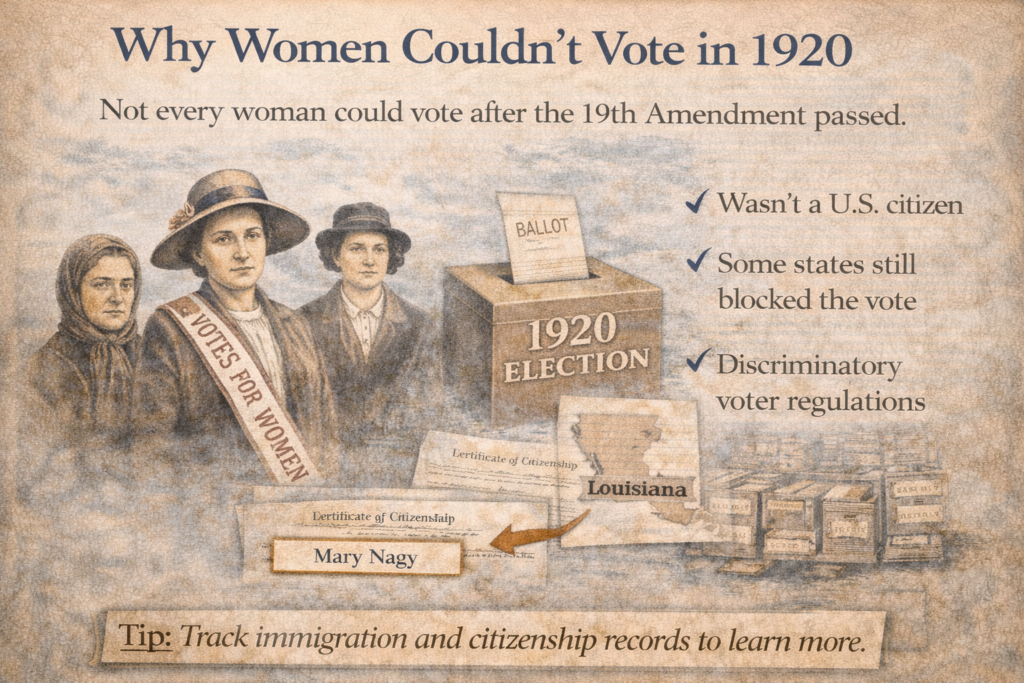
August 18, 1920. The Nineteenth Amendment is ratified. Women can vote. Across the country, women register at courthouses and polling places, ready to cast their first ballots in November. But some of those women — tens of thousands of them — are turned away. Not because of their sex. Because they are not citizens. The Nineteenth Amendment gave women the right to vote. It said nothing about citizenship. And for a significant number of American women in 1920, those were two entirely different problems.
The Nineteenth Amendment Was About Sex, Not Citizenship
The Nineteenth Amendment reads: “The right of citizens of the United States to vote shall not be denied or abridged by the United States or by any State on account of sex.” Every word matters. The amendment protects citizens. It says nothing about who is a citizen. Citizenship was governed by entirely separate laws, and those laws, in 1920, were deeply tangled for women in ways the suffrage movement had not fully addressed.
Voting required citizenship. The Nineteenth Amendment removed sex as a barrier to voting, but citizenship remained the threshold. A woman who was not a citizen could not vote — not because of any specific exclusion aimed at women, but simply because non-citizens do not vote in federal elections. If a woman’s citizenship had been stripped from her, the Nineteenth Amendment did not restore it.
The Women Who Showed Up and Were Turned Away
Under the Expatriation Act of 1907, any American-born woman who had married a foreign national between 1907 and 1922 had automatically lost her American citizenship on her wedding day. By 1920, this group included hundreds of thousands of women — women born in the United States, raised in the United States, who had never lived anywhere else. They had lost their citizenship not because of anything they had done wrong, but because of who they had married.
When these women arrived at the polls in November 1920, election officials who applied the law correctly turned them away. They were not citizens. The Nineteenth Amendment had given them the right to vote if they were citizens. It had not made them citizens. Those were two separate things and the law treated them as such.
The absurdity was widely recognized. An American-born woman who had spent her entire life in Ohio, married a man from Hungary, and never left the country could not vote in 1920. Her neighbor who had immigrated from Hungary, married an American man, and derived citizenship through that marriage, could vote. Citizenship law had produced an outcome that struck many people as obviously wrong.
The Other Women Who Couldn’t Vote
The women excluded by the 1907 act were the most visible group, but they were not the only women for whom citizenship was a barrier in 1920. Immigrant women who had arrived as single women and not yet naturalized were aliens and could not vote. Immigrant women whose husbands had not yet naturalized were aliens under the derivative citizenship rules and could not vote. Women from countries subject to racial exclusion laws — Chinese women, Japanese women, Filipino women — could not naturalize and therefore could not vote regardless of how long they had lived in America.
The Nineteenth Amendment was a significant expansion of voting rights. It was not a universal one. The women it helped were women who were already citizens. The women it did not help were women whose citizenship was in question, and in 1920, a great many women’s citizenship was in question.
What Changed in 1922
The Cable Act of September 1922 gave women independent citizenship status going forward — a woman’s citizenship would no longer automatically change upon marriage. Women who had lost citizenship under the 1907 act could apply to have it restored. The process was simpler than full naturalization but it still required an application and a court appearance, and it still generated records.
For genealogical purposes, this means that a woman who had lost citizenship under the 1907 act and wanted to participate in the 1924 election may appear in naturalization records in 1922 or 1923 — filing what amounts to a citizenship restoration — even though she was born in the United States. Those records are among the more unusual documents in American genealogy: an American-born woman, listed as an applicant for citizenship, in a record that exists entirely because of who she married sixteen years earlier.
If you have a female ancestor who was born in the United States, married between 1907 and 1922, and seems to appear in naturalization records in the early 1920s, this is the most likely explanation. The record is not an error. It is not a different person. It is your ancestor navigating the Cable Act process to restore the citizenship she lost on her wedding day. The record will typically contain her full name, her birthplace (a US state), her current address, her age, and her husband’s name and birthplace — all useful genealogical data even though it describes a process that should never have been necessary.
Trace your female ancestor’s citizenship history
The Naturalization Timeline Calculator covers women’s citizenship in every era — derivative citizenship, the 1907 Expatriation Act, the 1922 Cable Act, and more — so you can understand exactly what records to look for and why.