Why Your Eastern European Ancestor Was Recorded as Russian — Even When They Weren’t
You have been searching for a Ukrainian great-great-grandfather for years. You know roughly when he arrived, roughly where he settled, and roughly what his name was. But every search for Ukrainian records comes up empty. Then someone suggests you try Russian — and there he is. He was Ukrainian his entire life. He never once considered himself Russian. So why does every American record say he came from Russia?
The Map That No Longer Exists
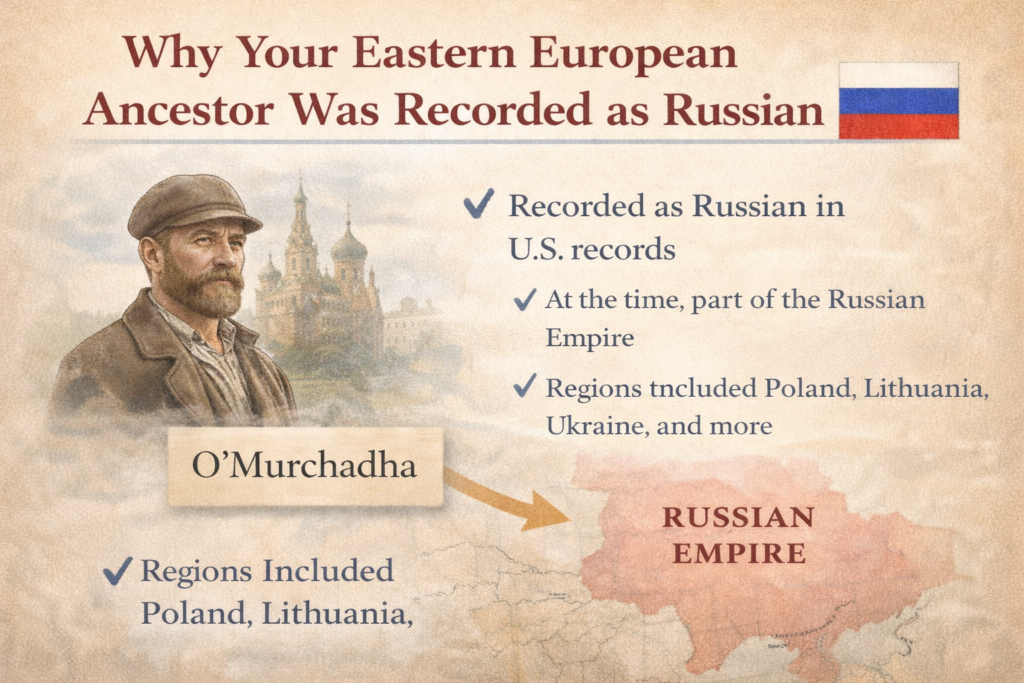
To understand why so many Eastern European immigrants were recorded as Russian, you need to understand what the map of Europe looked like in the decades before the First World War. The countries that today we know as Ukraine, Belarus, Lithuania, Latvia, Estonia, Finland, Poland, and large parts of Romania simply did not exist as independent nations. They were territories controlled by one of three empires — the Russian Empire, the Austro-Hungarian Empire, or the German Empire — and when their inhabitants emigrated, that is what their passports said.
A Ukrainian farmer from the Poltava region was a subject of the Russian Empire. His passport, if he had one, said Russia. The ship manifest recorded his country of origin as Russia. The American immigration officer recorded Russia. The census enumerator recorded Russia. He was Russian on paper from the moment he left home to the moment he died, despite the fact that he spoke Ukrainian, worshipped in a Ukrainian church, and identified entirely as Ukrainian.
What American records say vs. where your ancestor actually came from
Poland: A Country That Disappeared for 123 Years
Poland presents a particularly striking example of this problem. In 1795, Poland was partitioned between Russia, Prussia, and Austria and ceased to exist as an independent nation. It did not reappear on the map until 1918 — a gap of 123 years. Every Polish person who emigrated during this period — and millions did, particularly during the great wave of immigration between 1880 and 1914 — was technically a citizen of Russia, Germany, or Austria.
Census records from this period list Polish immigrants as Russian, German, or Austrian depending on which part of partitioned Poland they came from. Their mother tongue might be listed as Polish, which gives you the clue — but their country of birth will not say Poland, because Poland did not officially exist.
The Mother Tongue Column Is Your Best Friend
The US census from 1900 onward asked not only for the immigrant’s birthplace but for their mother tongue — the language they spoke at home. This column cuts through the political geography of empires and gives you the actual ethnic and linguistic identity of your ancestor.
An ancestor listed as born in Russia but with mother tongue Lithuanian is almost certainly Lithuanian, not Russian. An ancestor listed as born in Austria but with mother tongue Polish came from Galicia — the Austrian-controlled portion of partitioned Poland. An ancestor listed as born in Russia with mother tongue Yiddish was almost certainly Jewish, and the more useful search territory is Jewish community records rather than Russian civil records.
Lithuania and Latvia: The Baltic States Under Russia
Lithuania and Latvia were incorporated into the Russian Empire in the eighteenth century and remained under Russian control until 1918. Every Lithuanian and Latvian immigrant who arrived in America before the First World War was recorded as Russian. The languages are completely different from Russian — Lithuanian is one of the oldest living Indo-European languages, and Latvian is closely related to it — but the political reality of imperial citizenship overrode linguistic identity in the records.
The distinctive surname endings of Lithuanian and Latvian names are your best tool for identifying these ancestors in records that claim they are Russian. Lithuanian surnames ending in -auskas, -auskaite, -auskaitis, or -iene are unmistakably Lithuanian. Latvian surnames ending in -ins, -ans, or -ina are unmistakably Latvian. These endings appear even in heavily anglicised forms and can identify your ancestor’s true origin even when every official record says Russia.
Galicia: The Most Confusing Region of All
Galicia — a region that today spans southern Poland and western Ukraine — produced more confusion in American immigration records than almost anywhere else in Europe. Galicians were subjects of Austria, not Russia, which means Polish and Ukrainian immigrants from Galicia were recorded as Austrian rather than Russian. But the census enumerator asking about birthplace might write Austria, or Austrian Poland, or Galicia, or Poland, or even Russia if the immigrant couldn’t make themselves understood.
The same family might appear in different census years with different countries of origin listed, simply because different enumerators made different decisions about how to record a place that had complicated political status. Galicia is worth specifically searching for as a birthplace term in census records — some enumerators used it as a shorthand for the region even though it was not a country.
When searching for Eastern European ancestors in US census records, use these search terms for birthplace: Russia, Russian Poland, Russian Empire, Austria, Austrian Poland, Galicia, Austro-Hungary, Germany, German Poland, Prussia. Try each one separately. Then cross-reference with the mother tongue column to narrow down which part of the empire your ancestor actually came from.
After 1918: The Map Changes
The First World War ended in 1918 with the collapse of all three empires. Overnight, the map of Eastern Europe was redrawn. Poland reappeared. Lithuania, Latvia, and Estonia became independent. Czechoslovakia and Yugoslavia were created. Ukraine briefly existed as an independent state before being absorbed into the Soviet Union.
In the 1920 census — taken just two years after the armistice — you begin to see these new country names appearing in birthplace records. An immigrant who was recorded as Russian in 1910 might be recorded as Lithuanian or Polish or Ukrainian in 1920, because both the world and the available vocabulary had changed. This is why the 1920 census is so valuable for Eastern European research — it often gives you the most precise country of origin information available in any American record for your ancestor.
Find your Eastern European ancestor’s original name variants
Our Ancestor Name Bridge covers Russian, Ukrainian, Belarusian, Lithuanian, Latvian, Romanian, and Hungarian name transformations — helping you search across the name changes and the political geography that hides so many Eastern European ancestors.