Why WWI Changed Everything for Immigrant Soldiers
In April 1917, the United States entered World War I. Within weeks, the government began drafting men into military service — including hundreds of thousands of immigrants who had not yet naturalized. These men faced a situation without precedent in American history: they were being asked to fight for a country they were not yet citizens of, sometimes against the country they had come from. How the government handled this — and how it affected the immigrants themselves — created a documentary record unlike anything before or since, and left traces in the archives that researchers are still finding today.
The Draft and the Alien Problem
The Selective Service Act of May 1917 required all male residents of the United States between the ages of 21 and 30 to register for the draft — including aliens. An immigrant who had arrived in 1910, was living in Pittsburgh, and had never naturalized was legally required to register. When he appeared at the draft board, the registrar recorded his citizenship status: alien.
The draft registration cards from WWI — held by NARA and digitized on Ancestry and Fold3 — are one of the richest genealogical sources from the era precisely because they captured men who had never generated much documentation before. Every registrant’s card records their name, address, age, birthplace, occupation, employer, nearest relative, and citizenship status. For immigrants who were aliens, the card often records their country of origin and sometimes their specific birthplace in a level of detail that no other American record had ever captured.
If your male immigrant ancestor was of draft age during WWI and had not yet naturalized, there is almost certainly a draft registration card for him. It may be the most detailed biographical record he ever generated in America.
Enemy Aliens and the Registration Problem
The declaration of war against Germany and Austria-Hungary in 1917 immediately created a legal problem for immigrants from those countries. Men who had come from Germany or the Austro-Hungarian Empire and had not yet naturalized were now classified as enemy aliens. They were required to register with the federal government, carry their registration papers at all times, and report any change of address. They were prohibited from living near military installations, munitions plants, or waterfront areas. Some were interned.
The enemy alien registration records are a distinct and under-used genealogical source. They typically record the immigrant’s full name, address, occupation, physical description, birthplace, arrival date, and a description of any family members still living in the enemy country. For German and Austro-Hungarian immigrants who arrived before WWI and had not yet naturalized, the enemy alien registration may be the most detailed document generated by the American government about them at any point in their lives.
The 1918 Soldier Naturalization Act
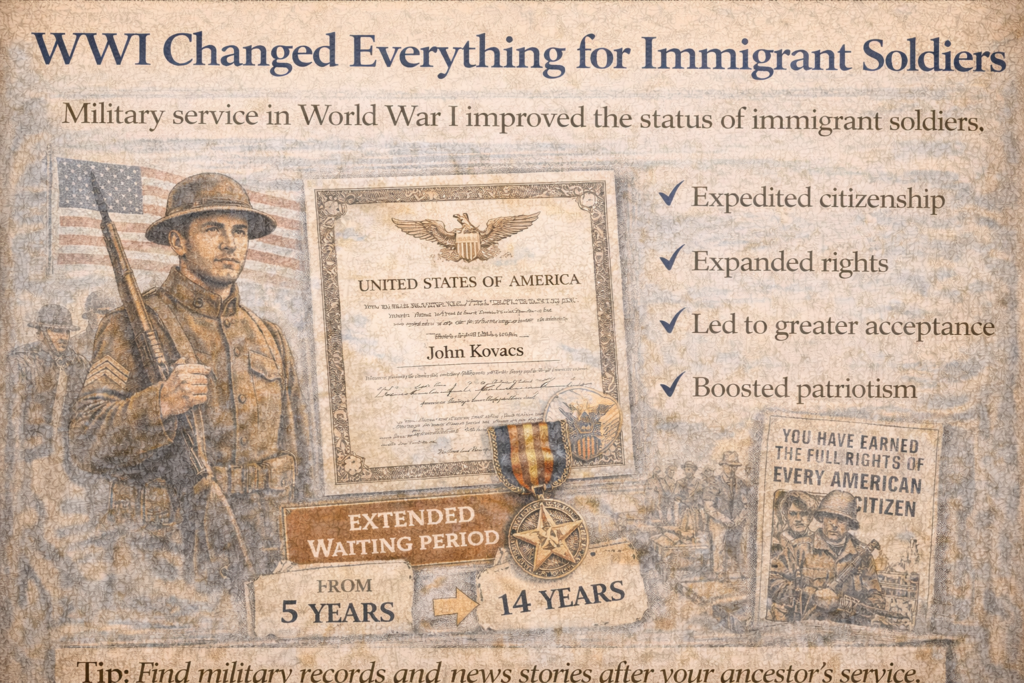
The Act of May 9, 1918 offered immigrant soldiers a straightforward deal: honorable service in the US military could substitute for the residency requirement. An immigrant who had arrived in 1915, enlisted in 1917, and served honorably could petition for naturalization in 1918 after less than three years in the country — bypassing both the five-year residency requirement and the requirement to have previously filed a Declaration of Intention.
The act was broadly used. An estimated 192,000 men naturalized through military service during WWI, representing a significant portion of all naturalizations in those years. These men appear in naturalization indexes under their own names, but their records have distinctive features: the petition will typically note the military unit, the dates of service, and the specific statutory authority — usually the 1918 act — under which the expedited naturalization was granted.
The Records That WWI Created
WWI generated an unusually dense cluster of records for immigrant men, many of whom had previously left a thin documentary trail. A single immigrant man who was of draft age in 1917, came from Germany or Austria-Hungary, and served in the US military may appear in all of the following: the 1917 draft registration card, the enemy alien registration (if he delayed naturalization), the military service record, the military naturalization record, and the 1920 census recording his newly achieved citizenship. Taken together, these documents can reconstruct a detailed biographical picture of someone whose pre-1917 American life was documented almost entirely in census entries and maybe a ship manifest.
For any male immigrant ancestor born between 1887 and 1897 who was living in the United States in 1917, search first for a WWI draft registration card on Ancestry or Fold3 before looking for any other record. The cards are almost universally digitized and indexed, they cover citizens and aliens alike, and they frequently contain birthplace information at the village or town level that appears in no other American record. If the card lists him as an alien, the next search should be for an enemy alien registration if he came from Germany or Austria-Hungary, or for a military naturalization record if he served.
Understand how WWI changed your ancestor’s citizenship timeline
The Naturalization Timeline Calculator includes the 1918 military naturalization act and shows you exactly what documents your ancestor’s service generated and where to find them.