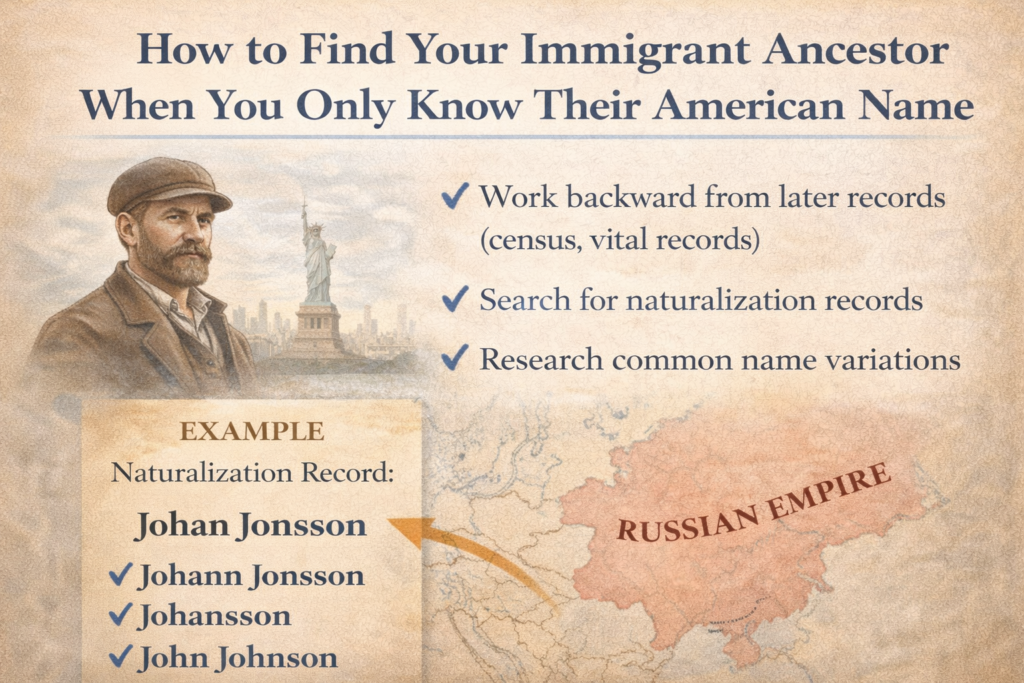
How to Find Your Immigrant Ancestor When You Only Know Their American Name
You know your great-great-grandmother as Mary Fisher. You know she was born somewhere in Europe around 1860. You know she arrived in America sometime before 1880. And that is everything you know — because the trail goes cold the moment you try to cross the Atlantic. What was her name before she was Mary Fisher? Where exactly did she come from? How do you find a person when you only have the name they became, not the name they were born with?
Why the American Name Is Not Enough
Immigrant ancestors present a unique research challenge because they exist in two separate record systems that are connected only by the person themselves. American records — censuses, naturalisation documents, death certificates, city directories — know them by their American name. European records — church baptisms, civil registration, military conscription, passenger departure lists — know them by their original name. Finding your ancestor requires building a bridge between those two worlds.
The name they arrived with and the name they ended up with may be very different things. Mary Fisher may have arrived as Maria Fischer, or as Marija Fischerova, or as Miriam Fishman, or as Marie Le Pêcheur — all of which could reasonably anglicise to Mary Fisher under the right circumstances. The country of origin completely changes the original form of the name, and you cannot search European records without knowing which original form to look for.
Step One: Extract Everything from American Records First
Find them in the latest possible US census
Start with the 1920 or 1930 census — the latest one available that your ancestor would appear in. These records ask for birthplace, mother tongue, year of immigration, and citizenship status. This information is your foundation for everything that follows. Write down every detail, even ones that seem irrelevant.
Work backwards through every census year available
Find your ancestor in 1910, 1900, 1880 — every census year they would have been alive and in America. Ages will vary. Birthplace details may become more or less precise in different years. Earlier censuses sometimes give a more specific country or region than later ones. Collect every variant and note the discrepancies.
Find the death certificate
Death certificates often record birthplace and parents’ names — information provided by a family member who knew the person. The informant on a death certificate was frequently a child or spouse who actually knew where the deceased was born. This can give you a specific town or region that census records may only describe vaguely as “Germany” or “Russia.”
Find the naturalisation record
If your ancestor became a US citizen, the naturalisation process generated multiple documents. Declarations of intent and petitions for naturalisation often recorded the applicant’s birthplace very precisely — sometimes down to the specific town — along with the original name, the date and port of arrival, and the name of the ship. This document alone can unlock an entire European research trail.
Step Two: Identify the Likely Original Name
Once you know the country or region of origin and the approximate immigration year, you can work out the likely original form of the name. This is where understanding name transformation patterns becomes essential.
A woman named Mary Fisher who came from Germany in 1875 was probably Maria Fischer or Marie Fischer in German records. The same woman from Poland might have been Marija Fischerova or Maria Rybacka (Rybacka being the Polish feminine form of Rybak, meaning fisherman — the same meaning as Fisher). From Ukraine she might have been Mariya Rybachenko. From the Netherlands she might have been Maria Visser.
Step Three: Search the Passenger Records
With a likely original name and a narrow immigration window, you can now search passenger records effectively. The major databases — Ancestry, FamilySearch, Ellis Island Foundation — all have significant passenger record collections. Search with the original name variant rather than the American name. Search with wildcard characters if the database supports them. Search by first name only if the surname search returns nothing.
Remember that the passenger list was prepared at the European port of departure, not at the American arrival port. The name on the list reflects what the European clerk wrote down. If your ancestor left from Hamburg, the list was prepared by a German clerk and will reflect German spelling conventions. If they left from Liverpool, the list may reflect English attempts at Irish or Polish or German names.
The Hamburg passenger lists (1850–1934) are among the most complete pre-departure records in the world and are freely available on Ancestry and FamilySearch. If your ancestor emigrated from anywhere in Central or Eastern Europe, there is a good chance they left through Hamburg and appear in these lists — often with much more detailed personal information than the American arrival records contain.
Step Four: Cross Into European Records
Once you have a passenger record, you have the name as recorded at departure and often a specific hometown or region. That information is your entry point into European records. Church records, civil registration, military conscription lists, and land records in the country of origin will use the original form of the name — which may look very different from anything you have found in American records.
For most European countries, civil registration of births, marriages, and deaths began in the nineteenth century — often in the 1830s to 1870s, depending on the country and region. Before civil registration, church records are your primary source. Catholic, Lutheran, Orthodox, and Jewish community records survive in varying states of completeness across Europe, and many have been digitised and are accessible online.
When the Trail Still Goes Cold
Sometimes, even with the right original name and the right country, the European records simply are not there. Wars, fires, deliberate destruction, and simple neglect have claimed vast numbers of records across Europe. A village in Ukraine or Poland or Lithuania may have had its records destroyed multiple times in the twentieth century alone.
In these cases, the research strategy shifts from finding records to building context. Who else in your ancestor’s American community came from the same region? Immigrant communities were tight-knit — people from the same village often settled in the same street. Finding your ancestor’s neighbours and tracing their origins can sometimes indirectly identify the village your ancestor came from, even when direct records no longer exist.
Start by finding the original form of the name
Enter the American name and country of origin into our Ancestor Name Bridge and we will show you the likely original forms to search in passenger records and European archives.