Why You Can’t Find Your Ancestor — They’re Hiding Behind a Nickname You Don’t Recognise
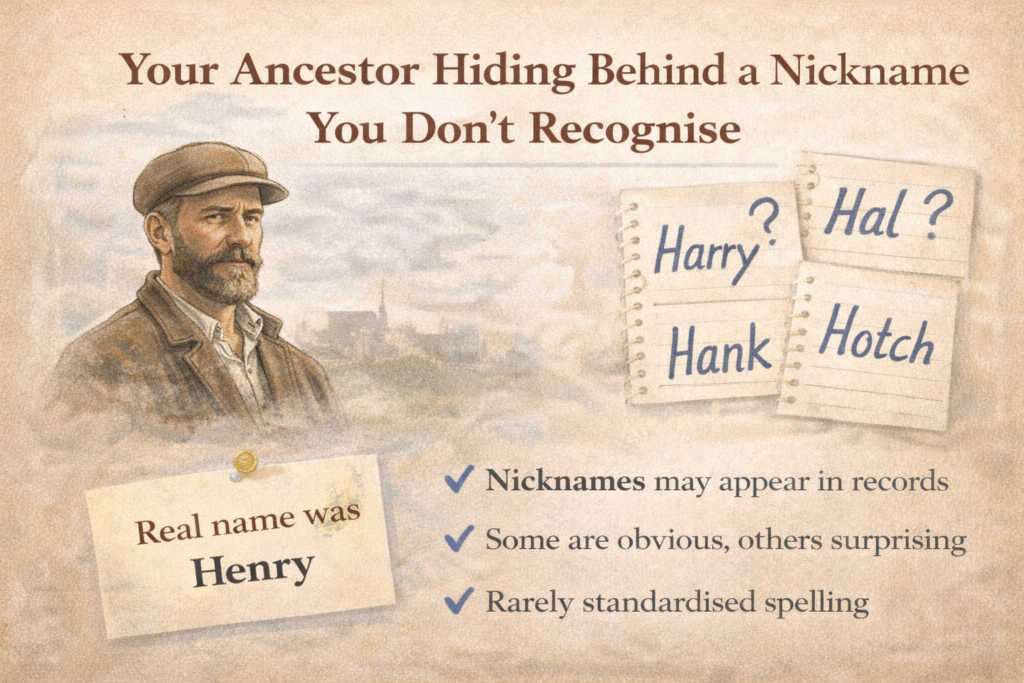
A researcher once spent three months searching for a family she knew existed. She had the parents, she had the address, she had the census year. But the children were nowhere to be found. Then someone suggested she try searching for Polly instead of Mary, Peggy instead of Margaret, Ned instead of Edward. There they all were — the entire family, hiding in plain sight behind nicknames that hadn’t been used in a hundred years. This is one of the most common and most overlooked problems in genealogy research.
The Census Recorded What People Said
Census enumerators did not ask for formal names. They asked what they were told — and in nineteenth century households, what people were told was frequently a nickname that bore almost no obvious resemblance to the name on the baptism record. A woman who had been called Polly her entire life would say Polly. The enumerator wrote Polly. And the formal name Mary that appears on her baptism certificate, her marriage record, and eventually her gravestone is nowhere in the census at all.
This was not unusual or careless. It was simply how names worked in Victorian and Edwardian households. Formal names were for documents and clergy. Nicknames were for daily life. The gap between the two could be enormous — and for genealogists searching a century later, it can be the difference between finding an ancestor and losing them entirely.
The Rhyming Nickname System That Makes No Sense
Many of the most confusing Victorian nicknames follow a pattern that linguists call rhyming substitution — a nickname was created by rhyming with an informal version of the formal name, then the original informal version was forgotten, leaving only the rhyme.
Mary became Molly — an informal softening of the name. Then Molly rhymed with Polly, and Polly stuck. By the time a family was using Polly, the connection to Mary had been so thoroughly obscured that no one thought of them as the same name at all. A researcher looking for Mary would never think to search for Polly unless they knew the history.
The same process gave us Peggy from Margaret. Margaret softened to Meg. Meg rhymed with Peg. Peg became Peggy. Three steps from Margaret to Peggy, with no obvious connection remaining at the end. And yet every census researcher needs to know that Peggy is Margaret, because the enumerator absolutely wrote down Peggy.
🏷️ Victorian nicknames and the formal names behind them
The Completely Inexplicable Ones
And then there are the nicknames that follow no discernible logic whatsoever and were simply what a particular family called a particular person. Sis. Bub. Babe. Pet. Tad. Duke. These appear in census records as though they are perfectly normal names, recorded by enumerators who either didn’t ask or didn’t think to ask what the formal name was.
Sis was almost always a girl, short for Sister — a family nickname for the eldest daughter or the only daughter that sometimes persisted into adulthood and appeared on official documents. A woman recorded as Sis in the 1880 census might have a completely different name on her marriage certificate. She might have a different name again on her death certificate, provided by a child who knew her formal name even if no census ever recorded it.
Bub or Bubba was almost always a boy — short for Brother, the same logic as Sis. These family position nicknames are among the hardest to trace because they tell you nothing about the formal name and everything about where the person sat in the family hierarchy.
The Middle Name Problem Multiplied
Nicknames intersect with the middle name problem to create some of the most tangled searches in genealogy. A man named William John Smith might go by John — his middle name — in daily life, and be called Jack by his family — a nickname for John. In different census years he might appear as William Smith, John Smith, W. John Smith, J. W. Smith, and Jack Smith. Five records, five different apparent names, one person.
This is not a hypothetical. It was standard practice in many families to use the middle name in daily life, particularly when the first name was shared with a parent or grandparent. The eldest son named after his father would often go by his middle name simply to avoid confusion within the household. That middle name might then acquire its own nickname, taking the search even further from the formal name on the birth certificate.
Children Were the Worst Offenders
Children in Victorian households were particularly likely to be recorded under nicknames, diminutives, or pet names that bore little resemblance to their baptised names. A child named Bartholomew might be Bat or Barry or Tolly to the family. A child named Theophilus — a real name, used more than you might think — might be Theo or Phil or simply Fil.
Very young children were sometimes recorded under names that were essentially descriptive rather than personal. Baby. Infant. Little. These appear in census records more often than you would expect, particularly for children under two who had not yet fully acquired a personal name in daily family use.
How to Search When You Suspect a Nickname
The most effective approach is to search without a first name at all. Search instead by surname, approximate age, and location. This returns everyone with that surname in that area of the right age, regardless of what first name they were recorded under. It is slower than a name search, but it catches the Pollys and the Peggys and the Sises that a direct name search will always miss.
If you find a promising candidate whose first name doesn’t match, don’t dismiss them immediately. Check the ages of other household members, the husband’s or wife’s name, the location, the occupation. If everything else fits, the first name may simply be a nickname for the name you were searching for. Cross-reference with other records — marriage certificates, death certificates, church records — to find the formal name that the census nickname was standing in for.
Build a nickname list for every formal name in your family tree and search for each variant separately. A search for Elizabeth should also generate searches for Bess, Betsy, Betty, Eliza, Lisa, Libby, and Beth. A search for Margaret should generate searches for Meg, Peg, Peggy, Maggie, Marge, Rita, and Greta. The formal name and every nickname it could produce are all the same person in a census.
The Family That Was Always There
That researcher who spent three months searching for a family she knew existed — Polly, Peggy, Ned, and Sis — found them eventually. They were in the census she had searched a dozen times. They were in the right place, the right year, the right household. The parents were exactly who she expected. The ages matched perfectly.
She had simply been looking for Mary, Margaret, Edward, and a name she could never quite pin down. The family had been there all along, hiding behind the names their mother called them every morning at breakfast — names that felt completely natural in 1880 and look completely unrecognisable a hundred and forty years later.
They are almost always there. You just have to know what to call them.
Check which census years your ancestor should appear in
Once you know the nickname to search for, use our Ancestor Census Research Assistant to map out every census year your ancestor should appear in — so you know exactly where to look.